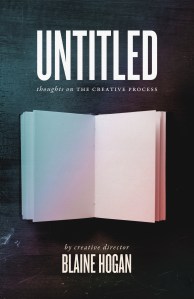
Just over a year ago I had the privilege of reading Blaine Hogan’s book, Untitled: Thoughts on the Creative Process. Blaine is the creative director for Willow Creek Community Church in Chicago, and was an actor for many years before that. He walks through the creative process every day, and when I stumbled across his book on Twitter I immediately wanted a copy.
Blaine hits on four main points in Untitled, the first of which is that creativity is hard. Despite what you might think, I found this really encouraging to hear. I’ve grown up with the idea that if you’re a real creative genius, the ideas flow and the work of putting it on paper is effortless. But as everyone discovers that is far from the case, and hearing someone acknowledge this and then offer ways to press through the hardship was amazing. Blaine then goes on to talk about risk, how to handle fear and failure, and why it’s all worth it.
In a way, you could say that Untitled is about dealing with the emotions of creativity. This isn’t a how-to book or steps to making good art, but rather a journey through what it means to be an artist and how to think about and deal with the obstacles that get in the way.
One of Blaine’s thoughts that really struck home for me was a line at the end of part two: “You are not a salesman. You are storyteller.” As an artist who is a Christian, my goal is not to sell people my belief in God, but to take people on a journey through that faith and relationship. (I wrote about it here.)
I readUntitled initially as an ebook, and my immediate thought was I would love to have a printed copy of it. I knew it would be one of those books that years from now still sits on my shelf, dog-eared and marked up, worn and bent from constant use. The great thing is, next week Blaine is at last releasing just that, with revised and expanded content.
There have been a number of books coming out the last couple years by Christian authors talking about creativity and how to mix it and our walk with the Lord. Out of those, Untitled: Thoughts on the Creativity Process is forefront in my mind when recommending books to others.
Recently a close friend emailed me with some deep questions about creativity, how to choose between lots of ideas, and how to deal with art of “embarrassing quality”. My response of course isn’t perfect, but I thought it may help others in their creative lives. Below is a modified version.
A Letter to an Artist
Dear _________,
In the first half of your email you mention wanting to do a lot of different things, but not knowing which one to pick. First, I think having a long list is awesome. Everything you listed off I can totally see you doing. I think the issue is trying find just one thing to do. I grew up wondering what “my calling” was, and we have a tendency to think there is one big thing that the Lord has predesigned and predestined us to do. While the Lord has designed us a specific way and has a wonderful path for us to walk, I think that approach to life is a bit off and puts a lot of pressure on us to the find the One Thing that we will do the rest of our lives.
A better way to look at it is in terms of calling and assignments. We all have one calling: Love the Lord our God with all of our heart, soul, mind, and strength, and love our neighbors as ourselves. Whether we are writers, filmmakers, accountants, preachers, musicians, astronauts, mothers, or invalids, that is the one thing we are called to do our entire lives. But in the midst of that, the Lord gives us different assignments. When I was growing up, my assignments were going to school, playing drums at church, and being a son and member of my household. Nowadays, my assignments are managing a team of editors, being a part of a 24/7 prayer ministry, and being a good friend to people around me. In a few years, my assignments will again be totally different.
Many of us like to do a lot of different things, and they can seem at odds with one another. I like writing books—but I also like editing—but maybe I like directing too—but what about living Portland with family?—or maybe traveling and making videos of what God’s doing around the world—or whatever else might suddenly spring up when I meet my wife and our interests are joined together—or something I never knew was in me suddenly springs to life.
But when I look at life through the lens of assignments, and know that the Lord is guiding me through the seasons of life to the particular place he needs me in at that moment, and that I have fifty more years to get through all of those seasons—suddenly the pressure is lifted. I could be a novelist for ten years, then a filmmaker for ten years, then maybe a world traveler for ten years, then, uh… golly, I still have twenty left out of my fifty. So instead of worrying about which grand thing I’m called to, I can spend my energy hearing God’s voice and discovering which assignment he has for me right now, and then focus on being faithful in that.
(Side note: assignments often overlap, and you also can (and should) prepare for future assignments while you’re waiting to get there.)
– – – – –
Now, to the second half of your email.
Your first question is, “Do you often start and never finish?” Yes, all of the time. Second question: “Are your first drafts ever of almost embarrassing quality?” Absolutely. It’s the first attempt at getting what’s in my head out into the physical world, and I rarely get it right on the first try. Third question: “If so, how can you see a first draft and have hopes that it might in turn become something worthwhile? What motivates you to keep molding what you’ve already started?”
Ah, now we get to the meat of it.
I think there are three stages of the creative process. There’s The Dreaming Stage, where you have this great idea and it sends chills down your spine and you can sit for hours staring out the window imagining how great it will be to have the finished piece in front of you. What you’re dreaming of is The Finished Stage, that moment when you sit back and look proudly at the piece and can show it to the world. That part is full of pride in a job well done and congratulations and the glow of achievement. (We hope, at least.)
But then there’s the middle part. I don’t have a name for it yet, maybe because it’s so awful. Let’s call it, um, The Desert Stage. This is where the rubber meets the road. This is where the mother screams on the birthing table. This is where you’re halfway up the mountain instead of looking up at its majesty or looking down from its grand heights. This is the part where you’re five minutes into your jog and your lungs burn and your legs ache and YOU JUST WANT TO BE DONE.
We try to avoid the Desert Part like the plague. Or at least I do, so I assume other people do. We look for shortcuts and we buy books like “Quick Steps to Success!” When we can’t find any, we usually quit. Personally, I’ve often sat down to write with grand passages sweeping through my mind, but when I put pen to paper the words screech out like a broken dishwasher. I read back the words with deepening despair. This isn’t how I imagined it to be. So I close the notebook and walk away.
But that moment right there is critical. That’s the moment that separates people who dream about things and people are do things. I think this is part of what God was talking about with Adam and Eve after they sinned. Though he spoke to Eve about childbirth and to Adam about farming, both were about bringing something forth and both were guaranteed pain. “In pain you shall bring forth children,” he said to Eve, and “By the sweat of your face you shall eat bread,” he said to Adam.
This side of eternity, hard work is part of the creative process. It seems like we should have divine inspiration from Holy Spirit—which we definitely get sometimes! But more often than not it takes dedicated, consistent work to produce something. It’s just a fact of the process, and once we accept that, we can move on to making good things.
So, we’ve accepted that part. Got it. I got my headband on, my shoes laced up tight. Now what?
You have to start making.
But don’t stop when it feels bad! It probably will, especially if it’s something you haven’t done before. Creativity in any art form, from writing to painting to dancing to singing, is a muscle and it needs exercise. It’s funny how we totally accept that a doctor has to go through years and years of training, or that a runner has to run miles upon miles in order to be good enough for the Olympics. Creativity is no different.
That’s where the embarrassing first draft comes in. Personally I think you just need to get something down first. It would take me FOR EVER to write this email to you if I wrote a line, analyzed it, rewrote it, then wrote the next one, reread it, then adjusted the first sentence to match it, then wrote another line, then reread all three…. Part of the creative process is about gaining momentum, and if you’re always stopping and going back to review you’ll never progress.
See, here’s proof
Last year I started writing a book, and I decided to write at least 15 minutes a day. It didn’t sound like much, but since I hadn’t worked that muscle much I wanted to start small. And let me tell you, most times when I sat down to write it was awful. You can look through my spiral notebook and see a lot of pages where I scribble on the side things like “Ick!” or “Oh gosh this is awful”. I knew the words were wrong, there was no rhythm or poetry to the lines, and the dialogue was clunky and unnatural. But I kept going because I knew I could always do a second draft.
Don’t put the pressure on yourself to produce something awesome the first time around. The first latté you ever made wasn’t mind-blowing, was it? But you kept making them again and again, and over time you became a great barista. Creative works function the same way. Keep working at the things you love to do, and over time not only will you get better but the process will become more enjoyable and you’ll probably find you can do things faster and more easily. A runner gradually learns to love running and can run for longer distances. They still break a sweat and work hard, but they learn how to make it through the Desert.
– – – – –
Lastly, don’t forget to include Holy Spirit in this. He loves hanging out with you and working with you as you create things. He loves seeing how you think and what you come up with. So it’s not just you persevering and gritting your teeth and pushing through the hard times (as Anne Lamott proposes in her book Bird by Bird). The joy of the Lord, as he looks at you and sits beside as you create, is your strength. So don’t be afraid to invite him into the process! He is like a dad who pulls his daughter into his lap, with all her papers and markers, and looks over her shoulder as she draws, whispering in her ear how much he loves the drawing and how much he loves her.
You aren’t on this journey alone. And not only does Daddy want to create with you, he also wants to meet you in those moments of doubt or fear. When things like that come up, sit down and ask Holy Spirit what’s going on. Why are you afraid? Why does it bother you? And what is the truth? How does he see you and feel about you?
Just like how learning to walk through marriage is an opportunity to bring us closer to the Lord, learning to walk through creative works is an opportunity. The end of the story is that you come out not only having grown in skill and talent and perseverance, but you come out of the Desert walking just a little closer to Jesus and holding his hand just a little more tightly.
In the 2012 presidential election, I was really hoping to be a good voter. I watched the debates and read the articles, trying to get a sense of the men running for president. I didn’t agree with all of Governor Romney’s positions, but for the most part I thought he was a strong leader and a good candidate, especially given our nation’s economic problems. I particularly liked Paul Ryan.
As Election Day approached I knew the race would be close, but I thought Governor Romney could pull it off. Given the high unemployment, general dislike for universal health care, an unpopular financial bailout, a 14-trillion dollar deficit, and not having really accomplished much in his first term, how could President Obama win with all the general unrest I felt in the nation?
But he did.
In the days since November 6th, the reasons why he won are slowly dawning on me. This election proved the issues weren’t about economy, unemployment, or results. This election was really about the ethnicity and character of a nation.
Ethnicity
A look at exit polls reveals something startling in the ethnicity of who voted for which candiate. NBC reported:
[The Obama campain] carried a whopping 93% of black voters[…] 71% of Latinos[…] and also 73% of Asians[…] What’s more, despite all the predictions that youth turnout would be down, voters 18-29 made up 19% of last night’s voting population[…] and President Obama took 60% from that group.
In contrast, NBC states that “89% of all votes Mitt Romney won[…] came from whites.”
As Kyle Baxter points out, “The GOP has tied itself to whites—specifically, older, male, evangelical whites”. But America is changing. The New York Times reported in May that “White births are no longer a majority in the United States.” With that shift, the Republican party is now fighting for votes it never needed to have.
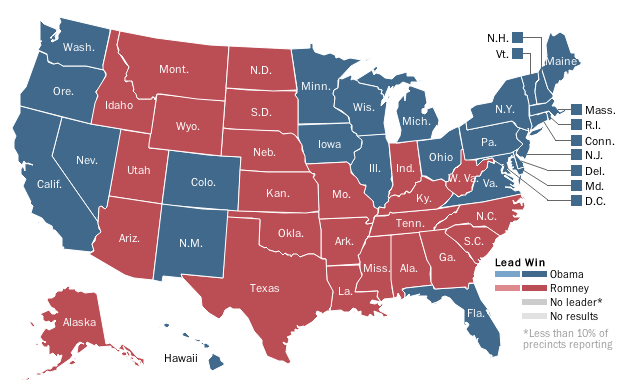
You can clearly see the shift when you look at the 2012 electoral map. When I saw this on Election Day, the layout of the states immediately stuck out to me. Governor Romney took nearly all of the middle portion of the U.S., while President Obama took nearly all of the coastal states. If we generalize, we could say that the mid-continental states are predominantly white farmer communities, while the coastal states are bustling centers of immigration and young people.
But why can’t the Republican party seem to capture the votes of these emerging demographics? This, I believe, comes down to something that transcends ethnicity.
The Character of a Nation
The day after the election, David Simon, creator of the HBO show The Wire, wrote:
I was on an airplane last night as the election was decided. As the plane landed after midnight on the East Coast, I confess that my hand was shaking as I turned on my phone for the news. I did not want to see dishonesty and divisiveness and raw political hackery rewarded […] But the country is changing. And this may be the last election in which anyone but a fool tries to play — on a national level, at least — the cards of racial exclusion, of immigrant fear, of the patronization of women and hegemony over their bodies, of self-righteous discrimination against homosexuals.
There is a fundamental shift happening in the worldview of the United States. Evangelicalism is declining, opening the door for a more liberal approach to life. Biblical doctrines are being seen as quaint and outdated, and a new generation, which is experiencing a global connection unlike any in the past thanks to the Internet, is deciding they want to be more inclusive. People in Africa or the Middle East live a certain way and we accept them, so why shouldn’t we accept different views in our own nation?
Thus, three states approved gay marriage amendments, several openly gay politicians were elected, and a pro-choice, pro-gay president was re-elected. Further, people like Baxter and Simon are saying, “The current GOP is wrong politically and wrong morally. We must re-make it.”
“Wrong morally.” This isn’t just about thinking one candidate’s policies are better than the other. The very nature of how American citizens see the world is changing. What used to be called biblical values is now being called, “the patronization of women and hegemony over their bodies” and “self-righteous discrimination against homosexuals.”
Again from Simon:
[R]ight now, the conservative movement in America is fleeing from dramatic change that is certain and immutable. A man of color is president for the second time, and this happened despite a struggling economic climate and a national spirit of general discontent. He has been returned to office over the specific objections of the mass of white men. He has instead been re-elected by women, by people of color, by homosexuals, by people of varying religions or no religion whatsoever.
These words will not fall on deaf ears; Republicans, as much as any other political group, want to win votes and be in positions of power, and if it takes compromising on “core” values to get them, they will, because we are all human, and without Jesus biblical values are a convenience. As Baxter also wrote:
[W]ithout fixing these issues, the party doesn’t stand a chance. The first step is to change the party’s positions on the issues listed, and to call out the intolerant elements within the party who have gone untouched for too long.
How Then Shall We Live?
This is the first political post I’ve written on my blog. As the header states, my usual topics are “Creative Writing, Jesus, and Media”. So how does the election fit in?
At first I wasn’t sure if it would, but after thinking over the moral issue I realized it all comes down to my relationship with Jesus. The question I’m asking him is, “If my nation is continually walking away from what You say in the Bible, what do I do with my beliefs?”
An obvious answer is prayer. Regardless of my beliefs, President Obama has been re-elected as the leader of my nation, and I will honor him and pray for him. Also, despite the change happening to those around me, I really do believe that God can turn a nation back to him—not back to Republican values, but to him. How many times did Israel turn from the Lord, only to come back? (Of course, that usually involved captivity or occupation by another country, but that’s a topic for another day.)
But the real tension comes in every-day life. When I interact with homosexuals, or talk with parents who think it’s fine for their five-year old son to become a girl, or read articles like Simon’s that vehemently rejects biblical conservatism, or when I next go to vote, what will my actions be?
Do I say that I believe homosexuality is wrong, but that’s just a personal conviction and it’s okay for you to do what you want because we are a free country? Do I stop saying that abortion is wrong? Well, actually that argument I’m at least sure of; I don’t see how you can look at a ultrasound and not see it as life.
Huh. That last paragraph is interesting. The economy seems like an easy case of numbers, and foreign policy just an exercise in being nice to other nations and being careful where we send guns and bullets. But somehow the real fabric of America’s turmoil can be boiled down to the definition of love and life. Jesus seems pretty clear on these issues—and more and more my homeland is walking away from them.
I’m not going to propose an answer, because in all honesty I don’t know what to do. Our nation is abandoning its Christian roots and I have no arguments against it except my belief in Jesus and his words. What do you do when your nation no longer recognizes that as an acceptable argument?
When you think about it, though, that’s what most of the world experiences. The United States of America is a rarity in history, and I wonder if it has caused us to become complacent in how we walk out our relationships with the Lord. Everyone seemed to go along with our beliefs, so we coasted by.
Now that we are truly confronted with the tension of being in the world but not of it, what will we do?
UPDATE: Daniel Lim, a teacher and missionary, spoke to the students of the International House of Prayer University, a ministry school in Kansas City, Missouri. He provides a clear, urgent answer to my question.
UPDATE 2: A few people have expressed concern that in my post I implied those who voted for President Obama are immoral and walking away from Jesus, and that I think very lowly of them. Regardless of varying opinions, I want to always honor and value you, the reader, and I sincerely apologize for coming across like that.
The room is full of soft chatter and the light clicking of keyboards. Eleven students cluster around their computers, and I sit at the front of the room, my dress shoes facing forward and my eyes wide open.
It’s a far cry from three weeks ago.
Ever since high school I’ve been cultivating a habit, and it is (or was, thank God) very much a bad one. Maybe you got into the habit, too: staying up late. Gone were the days of early bed times; these were the nights of my youth, and I spent them with a vengeance. Even without the help of a gaming system (my first Xbox coincided with my first year of college, thanks to a tuition refund), I still averaged a bed time of midnight or later. I’ve maintained it ever since.
Some may say they do their best work at night, but if I was really truthful I couldn’t tell you it was for productive reasons. Sure, there was the occasional night spent working on a short film or essay for college, but for the most part it was books, internet, gaming, or staying out with friends. With each passing year my body’s clock was impressed more and more with a nocturnal emphasis. But in spite of all that, somehow I was still able to get up in the morning. I still managed to drag my tired body out of bed and make it to my 8am lecture classes.
I must be getting old, because that ability has fled. A decade of staying up late has caught up with me, as I was horrifically reminded of three weeks ago.
I woke to pounding on the front door. The room was dim and blurry. I scrounged for my phone, blinked at the glaring screen. My blood ran cold. I was two and a half hours past my alarm going off. I was late for picking up a coworker and arriving at work. Worst of all, I was late for my first teaching session with a new batch of media students. Several calls and texts were missed. The pounding was from the fist of a worried co-worker.
As I drove to the school to teach the few students who had waited for me, I asked the Lord why he hadn’t woken me up. I knew I couldn’t fully accuse him, but I also couldn’t help from asking why.
He gave the perfect parenting expression: a grim smile, a slight shrug of the shoulders. “You gotta learn,” he said.
As stated, today is three weeks later. I’ve gotten up at least by 7:30am or earlier ever since—a goal I’ve been trying to reach for the last two years. I’m actually tired by 11pm, rather than just catching my second wind. I’m able to get to work on time, or get to class and teach about editing with a clear mind. And no crusties in my eyes.
That pesky, helpful habit
As long as we’re on the topic of high school habits, let’s talk about procastination.
Somehow it’s not just a high school thing, though, because I still do it all the time. Except instead of essays or book reports now it’s paying rent, folding my laundry because Mom isn’t going to, doing the dishes, taking my car in for a tune-up, mowing the lawn—sheesh, what’s up with all these grown-up things? I always wanted to grow up, but I thought it would be more exciting.
Of course, it really is more exciting. I live in a new city, I have new friends, I don’t have to tell anyone when I spend the night at a friend’s house. You know, all of the exciting things of adulthood. But there are still things to be done, and that pesky habit of procrastination still stays my hand.
Which is why I’ve started using it to my advantage.
For a while at work I used procrastination in the wrong way. Rather than buckle down and address the creative projects in front of me, I took frequent breaks on Facebook or Twitter. I checked tech blogs and news sites, thinking it was okay because my creative mind needed a break.
There were two downsides, one obvious, one insidiously hidden:
I didn’t get work done
I had too much on my mind
The second one revealed itself during a production meeting. We were talking about current projects and upcoming ones and what we needed for that conference and who we could possibly hire to help out with—and I just couldn’t keep it all in my mind. I was thinking about what my friends were posting on Facebook and what that tech writer might be posting about the latest gadget. I had too much on my mind.
So I decided to stop. When I was at work I would focus on work, and all that other stuff I could check later.
Crazy thought, I know. But it’s helped immeasurably. When the urge comes to check Facebook, I tell myself, “You’ll get to do that, but later. You’re at work, so focus on work.” Now I’m getting projects done. I’m able to wrap my mind around all that we need to do. And when I get home at night, I have a day’s worth of content to peruse while I make dinner.
Learning to be an adult
When I was in high school, I looked at the seniors and marveled. They had facial hair and looked so mature. I couldn’t wait to get that old. Years later, I often feel like I’m still waiting to get there.
But these past few weeks have started to change that. I’m getting up in the morning, and I’m getting things done. I think I’m finally starting to feel grown up. The process kind of hurt, but the Lord is patiently teaching me how to be an adult.
The house was quiet, save for those creaks and groans that all houses have (especially in the cold of winter) and the occasional rustle of a brother or sister turning in bed. The pale glow of Christmas lights fell across me, mingling with flashes from the TV. The fireplace flickered warmly as I tried to stay awake for my early-morning flight.
There was only me this late Christmas night. I had said goodbye to my older brother, his wife, and young niece. They had driven the entire previous day in order to get home before I returned to my job in Kansas City. There was my sister, my mother, and two little brothers, one of whom would stumble out of bed to drive me to the airport. They lay sleeping while I sat weeping, for I did not want to go.
I was six months into living on my own, in a new city for the first time ever. I was doing what I loved and making new friends. But it wasn’t home yet. This was home. And I had to leave it.
Change is something I’m still learning to deal with. I haven’t been alive long, only a measly twenty-seven years—at once so old, yet so young. I don’t know what it’s like to do something long-term; the longest time period I have ever spent on one thing was college, and that was only five years. I don’t know what it’s like to move to a new place, make new friends, and then leave those friends. I don’t know how to gracefully, graciously transition from one season of life to another.
Or at least, I don’t fully know, because that is something that comes through practice. But I’m learning. And that night as I cried and asked the Lord why I had to leave, he taught me something new.
“Life is full of oases,” he said. (That’s oasis, but plural.)
Growing up is one oasis, an especially long one. For me, my growing-up oasis was amazing. The Lord blessed me with incredible parents and siblings, lifelong friends, a church family in which to grow and mature, and a hometown whose wildlife and setting is mindblowingly beautiful. High school is usually another oasis, and then college.
An oasis is a place where you are safe. You have people who care for you and love you. An oasis is the warm arms of your father, the laughing and excitement of a night-out with friends, the silent car rides where no one needs to speak to cover up awkward silence. An oasis is the heavy covers of your bed during winter, the sound and smell of soup simmering on the stove, the deep breath you pull when you see something so beautiful it steals your breath away and you realize that here, now, you are truly, fully content.
But Life moves on. Transition, a new season, change—we try to gloss it over with many names, but we all know it. We all know the feeling when we pull back the blankets and the cold air hits our skin; we all know the feeling when we toss our graduation hats in the air and then realize you’ll most likely never stand next to these people again; we all know the feeling when we give Mom and Dad one last hug and drive down the road one last time, that road you could navigate in your sleep, that road on which you’ve walked barefoot and whispered to God and the stars, that road you’ve screamed at and begged for answers, that road, that road, that road….
We turn the corner, and the oasis slips from view.
Suddenly we are not safe. Suddenly we are adrift. “It was sea and islands now; the great continent had sunk like Atlantis.”
We arrive in the new place, but it is not home. There are people, but they are not friends. But we somehow know it’s right to be there, so we stay and smile, and eventually laugh and eventually make our own jokes with new friends in new places as we drive on new roads. And before you know it, you’ve found another oasis.
This is Life, you see. In his wisdom, God decided to let Life change and shift because he wants us to grow. He wants us to be stretched and transformed into the likeness of Jesus, so he uses the seasons of life to forge new things in our hearts. And he knew it would be hard, so he gave us oases.
An oasis is not meant to be a permanent location. It is meant to be a strengthening time for the journey ahead. God brings us up in childhood and surrounds us with love and family and friends, and then he pushes us out. We form new relationships and grow differently as new people pull us in new ways, and then we are pushed out. And then we are stretched and strengthened again, and then pushed out. And then strengthened, and then pushed out.
“It’s natural,” Daddy said to me as I cried in my living room that Christmas night. “Don’t fight the change; I want to use it! Cherish the oasis you were in and let it strengthen you for the journey I have planned next for you.”
Oh, we won’t be naive—this does not make the change any less painful. But know that the oasis you are in, or have just left, or are heading toward, is meant to propel you forward, and then again, and then again, until we at last reach those distant shores where there waits an unchanging Father, with unchanging love, and always open arms.
Then, surely then, we will enter rest, and never leave.
Reading, writing, fantasy, adventure, movies—it’s all been my favorite since I was 8 years old. If you enjoy reading fantasy, adventure fiction, and screenwriting, then you’re in the right place!
Join the fun!
Get fascinating adventure facts, insider access, and early looks at my latest stories