• Faintly through dim shadows came the alarm’s first sound and pulled me from sleep. I stirred and turned, blinking at its bright face. The digital numbers stared back at me; there was no denying it was time to get up.

    My bed begged to differ, however. “No, no, no,” it whispered. “ Ssssleep…. Just a few more minutes of blessed darkness.” I turned from the alarm and settled back into my bed’s soft comfort.

    —and then my eyes sprang open.

    It’s all about comfort.

    The western world lives for comfort. A warm bed, a hot shower, a rich cup of coffee. The moments are different for everyone, and for some perhaps few and far, but we spend a lot of time and money trying to get comfortable. We want to feel at peace, safe, secure, and we want nothing more than to stay there.

    And that turns out to be the problem: we don’t want to leave comfort. It feels so good that it surely should never end, so we watch the same movie a hundred times, or live with our parents till we turn 30. We cling to comforts and stay in them as long as possible.

    But I don’t think it was meant to be like that.

    There are moments of joy, and then there are moments between joy. That is the rhythm of life. Like it says in Ecclesiastes, there is a time for everything. There is a time for comfort, and then there is a time for work. Such is the way of things.

    Thinking about comfort in this way suddenly removes the pressure to hold onto it. Sure, the bed feels wonderful; sure, I would love nothing better to take a 30-minute hot shower. But moments of comfort aren’t meant to be stayed in forever. They are meant to fuel me for the work ahead.

    It will probably take a while for me to actually approach comfort like this. My habit now is to find it and cling to it as long as possible. But hopefully, if I stay mindful of this, I will be able to enjoy moments of comfort when they come and then step out when it’s time.

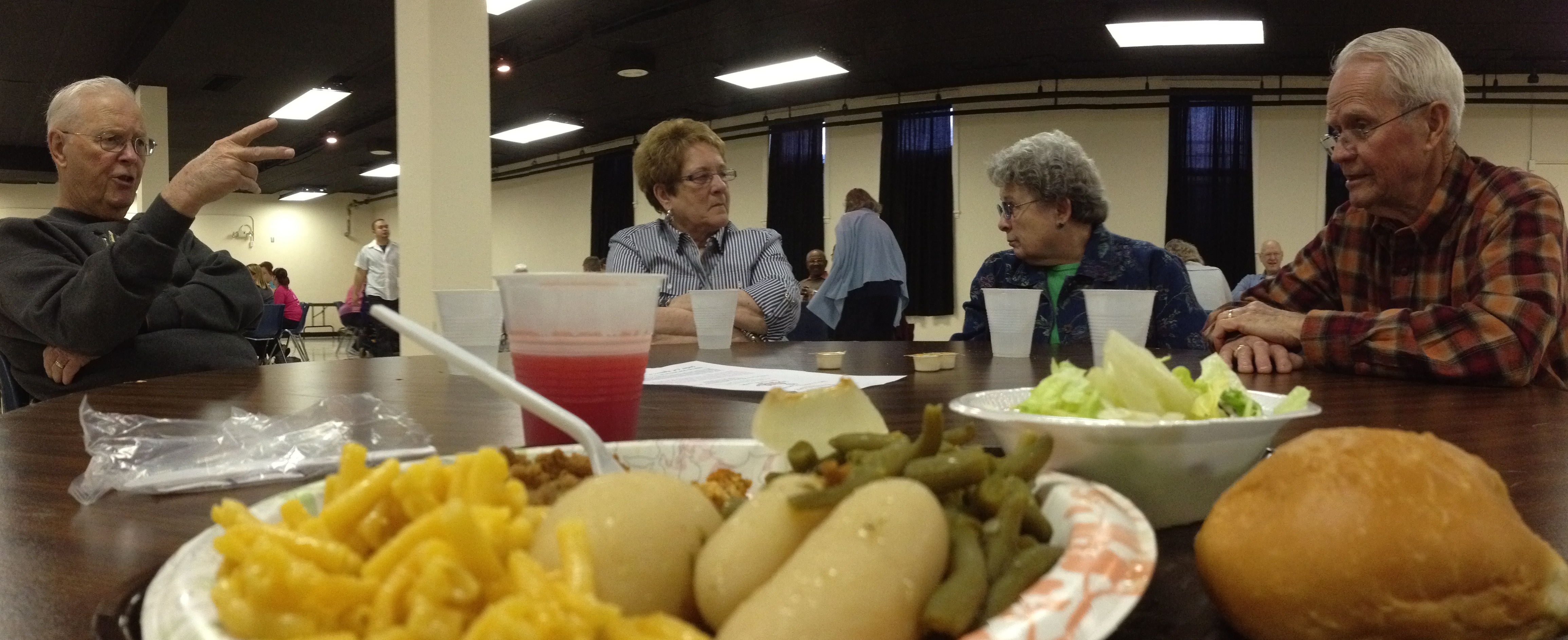
  • Friday Fish FryThe salty tang of lemon pepper and oil laced the air as I stepped from my car. The parking lot was mostly full. A cluster of tan uniforms milled around the open doors of a minivan to the left, and a young man with headphones sat in front of a cream-and-blue sign that read Our Lady of Peace.

    I headed toward a set of white double-doors. An older black man joined me. “Must be in the gym,” he said.

    “Must be,” I replied and held the door open for him. “Just follow the smell.”

    It was Friday, and it was fish fry night at the Catholic church.

    Recently I’ve been thinking about what governs my actions. The fish fry I attended, it turns out, was part of the Catholic tradition of Lent, where they fast something for 40 days. (I need to attend the next fish fry and ask how fish is tied in.) Jews have similar practices, with feasts, times of remembrance, things they can or cannot eat, etc. It can easily slip into empty tradition, of course, but I started to think about my own Protestant, legalism-free life. What governs my actions?

    I think I can boil it down to this: I make decisions based on if it will make me sin. Eat this cookie? Sure, why not. Read that book? It probably won’t make me sin, so sure. Watch that movie? Eh, it has a few bad scenes that might make me lust, so I’ll skip it. But what about how I interact with my roommates? Or whether or not I give to the homeless man on the street corner? Or how I speak about my government officials?

    Then there are things like drinking or chewing. I used to say that I didn’t have any biblical problems with drinking (Paul suggested a glass of wine with dinner, after all)—I just didn’t drink because I didn’t like the taste. But when I recently learned that one of my family members drinks an occasional beer… it suddenly just felt wrong.

    But can I biblically say it’s wrong? How do I biblically decide yes or no? Do Jesus’ actions have any bearing on how I act?

    Essentially, I think thus far my Christian walk has been an intellectual one. I study the Bible to see how Jesus feels about me, or to get a better spiritual understanding of the cross. But I’m beginning to wonder, does it have an impact on my daily actions? Yes, we should study the Bible; I definitely need a greater revelation of Jesus’ love for me. But am I making a conscious choice to apply that revelation to my actions?

    My relationship with Jesus is changing my thoughts, but is it changing what I do? Am I keeping the intellectual learning at an arm’s distance? Changed thoughts should lead to changed actions—are they? I try to be joyful, inviting, and serve others—but that’s just a moral code. Am I acting more like Jesus, the Son of God? Am I being transformed into his image? Am I putting off the old man of sin and becoming a new creation?

    Ha. Basically I’m asking myself, is my relationship with Jesus bearing fruit?

    My current Bible study is in the gospel of Mark. The goal when I first started was to look at Jesus and ask four simple questions: what does he do, what does he say, what does this show me about him, and what does this show me about God the Father?

    The unexpected side effect is I’m getting an understanding of Jesus as a real man. He felt dirt beneath his feet, he breathed oxygen, he talked with people, he slept and ate. I mostly ask questions as I read, but I feel like I’m connecting with the real man Jesus.

    After the fish fry, I added a fifth question: how can I apply what Jesus did and said to my actions?

    If he is a real man and if the way of the Lord, the way he desires me to live, is real, then there can be—there must be—real actions to apply to my life.

  • Silent momentsLight piano music filled the small L-shaped room. There were six chairs, one lamp, and a few magazines. To my right, the chiropractor sat behind his desk, going over paperwork. He had another patient coming before he could talk with me, so I pulled out my phone and started to read an article.

    The door, only a couple steps to my left, clicked open and a man from India entered. He set down a leather book bag and sat across from me, also pulling out his phone. We looked at our screens, the piano filling in the conversation-less space.

    “Ready?” asked the chiropractor, and he and the man stepped into the small office at the back of the room.

    I turned back to my phone, but a thought was pulling at the back of my mind. This was the third chiropractor I had been to in an attempt to relieve some lower back pain. I had jumped feet-first into a long treatment plan with the last chiropractor but, taking the advice of my mother, I was seeking another opinion. What was my response going to be? If he suggested similar treatment, would I switch to him? What was my financial limit?

    My phone rested in my hand. I could go back to reading, or I could take a moment and think.

    Lately I have noticed my desire to be occupied. I’m in line at the grocery store and I immediately pull out my phone to read. I’m driving home from work and I immediately turn on music or a podcast. I’m sitting at home and scroll through Instagram, then Facebook, then Twitter, then back to Instagram, then through the iTunes App Store to see if there are any new interesting apps.

    When was the last time I just sat? When I just looked around and let myself think?

    There are financial things to think about. Stories I want to write and haven’t figured out yet. Verses I read in the Bible this morning, or the pastor’s sermon from last Sunday (if I can even remember it). Friendships or work duties to consider. But instead my mind is occupied with other things, and I never get around to thinking about things that actually matter. Instead I play Angry Birds, or read an article about the demise of Apple since Steve Jobs died.

    Are these past times bad? Perhaps not. But if I don’t take advantage of the silent moments, when will I have time to process life?

    I slipped the phone into my coat pocket. The piano played and I thought. After a few minutes the door to the back room opened, and the chiropractor waved me in.

  • Looking back over this list I have a hard time believing I read all of these in one year. It seems so long ago that I discovered Kenneth Oppel’s mastery of words and his zeppelin world, or that Scott Westerfeld dazzled me with his Steampunk version of World War I, or that Chrisine Fletcher and Irene Gut Opdyke moved my heart with their historical stories. I read young adult fiction books fast and furiously in 2012—something I don’t think I’ll repeat—and some of them have definitely made it onto my all-time favorites list.

    After the list I’ll give some brief thoughts on ones I liked.

    1. 1/2–6: The Hero and the Crown, by Robin McKinley
    2. 1/10–16: Forbidden, by Ted Dekker and Tosca Lee (Kindle ebook)
    3. 1/17–20: Airborn, by Kenneth Oppel
    4. 1/21–22: Legend, by Marie Lu
    5. 1/23–27: Is that really you, God?, by Loren Cunningham
    6. 1/27–29: Leviathan, by Scott Westerfield
    7. 1/29–30: Artemis Fowl, by Eoin Colfer
    8. 1/30–2/2: Skybreaker, by Kenneth Oppel
    9. 2/3–10: The Keepers’ Tattoo, by Gill Arbuthnott
    10. 2/10–11: Starclimber, by Kenneth Oppel
    11. 2/12–19: The Eyes of a King, by Catherine Banner
    12. 2/20–22: I am Number Four, by Pittacus Lore
    13. 2/23–3/12: Six Days of War: June 1967 and the Making of the Modern Middle East, by Michael B. Oren
    14. 3/14–21: Innovate the Pixar Way, by Bill Capodagli and Lynn Jackson
    15. 3/22–27: Inheritance, by Christopher Paolini
    16. 3/28–30: This Dark Endeavor, by Kenneth Oppel
    17. 3/30–4/2: Across the Universe, by Beth Revis
    18. 4/3–7: Behemoth, by Scott Westerfeld
    19. 4/10–13: Ten Cents a Dance, by Christine Fletcher
    20. 4/16–19: Stardust, by Neil Gaiman
    21. 4/19-21: Goldstrike, by Matt Whyman
    22. 4/22-30: The Other Side of Life, by Kim Ablon Whitney
    23. 5/7–14: The Way We Fall, by Megan Crewe
    24. 5/14-17: Divergent, by Veronica Roth
    25. 5/18–25: The Death Cure, by James Dashner
    26. 5/25–30: A Million Suns, by Beth Revis
    27. 5/30–6/3: Goliath, by Scott Westerfeld
    28. 6/18–30: Three Cups of Tea, by Greg Mortenson and David Oliver Relin
    29. 7/9–12: Graceling, by Kristin Cashore
    30. 7/13–20: Fire, by Kristin Cashore
    31. 7/26–30: Bitterblue, by Kristin Cashore
    32. 7/30–8/4: Ranger’s Apprentice: The Ruins of Gorlan, by John Flanagan
    33. 8/4–11: The Name of the Wind, by Patrick Rothfuss
    34. 8/11–25: The Bourne Supremacy, by Robert Ludlum
    35. 8/30-9/3: Insurgent, by Veronica Roth
    36. 9/4–7: The Sky Village, by Monk and Nigel Ashland
    37. 9/7–10: Ship Breaker, by Paolo Bacigalupi
    38. 9/10–16: The Hawk and His Boy, by Christopher Bunn (Kindle ebook)
    39. The Drowned Cities, by Paolo Bacigalupi
    40. Edge Chronicles 1: Beyond the Deepwoods, by Paul Stewart
    41. Edge Chronicles 2: Stormchaser, by Paul Stewart
    42. In My Hands, by Irene Gut Opdyke
    43. The Secret Warning, by Franklin W. Dixon
    44. Theft of Swords, by Michael J. Sullivan
    45. The Way of Shadows, by Brent Weeks
    46. 12/9-22: Rise of Empire, by Michael J. Sullivan
    47. 12/22-25: Twilight, by Stephanie Meyer
    48. 12/25–1/7/13: Heir of Novron, by Michael J. Sullivan

    Free reading tip: About four years ago I started using an index card as a bookmark and would jot down the book I was currently reading and the dates of when I started and finished it. It helped motivate me to keep reading (gotta fill up the card!) and I like to imagine my kids (or biographers;) someday will enjoy seeing what I read.

    My Recommendations

    • Irene Gut Opdyke: Irene’s memoir about surviving World War II as a Polish girl is hauntingly beautiful. So well written, so poignant and tragic. There are parts in this I will remember for a long time, both from the story and how she wrote it. If you read any book on this list, read this one. (Many thanks to Jenn Sarver for lending it to me.)
    • Christine FletcherTen Cents a Dance is a fantastic historical fiction book set in 1940s Chicago. Christine captured the energy of swing dance (a style I learned in 2012), and also structures the story incredibly well. The main character learns something new each chapter, and difficult issues like prostitution are addressed by leaving things unsaid rather than going into unnecessary detail.
    • Kenneth Oppel: I stumbled across Airborn while perusing the shelves at the library. I had never heard of Kenneth, but was immediately gripped with the tightness of his narrative, his mastery of dialogue, and his subtle use of humor. I laughed aloud many times while reading Airborn and its sequels Skybreaker and Starclimber, and the endings of particularly the first and third books were jaw-droppingly brilliant. One of his latest books, This Dark Endeavor, is one of the most tense books I have ever read.
    • Scott Westerfeld: My introduction to Steampunk fiction was Scott’s Leviathan series. It took me a few chapters to get used to the world, but once I did it was a great series. The story is compelling and the world he dreamed up is brilliant.
    • Michael J. Sullivan: I found Michael’s blog and Twitter account a year or so ago and his blog posts on writing are fantastic. I then discovered out he was a self-published author who wrote a six-book fantasy series, which was later picked up by the publisher Orbit. When I finally was able to read the series, I found a well-written, well-plotted series. One of the great things about the Riyria Revelations is how Michael weaves the story together and slowly opens the story up to reveal more and more.
    • Paolo Bacigalupi: From the language (there are a few swear words) and style of writing to the struggles of the characters, the world Paolo created in Ship Breaker and The Drowned Cities is harsh and unforgiving. The books are very well written and the world is well formed. Post-apocalyptic novels are a current trend, and like the others the story here is a young boy or girl trying to hang on to their humanity in a world that refuses to let them have it. The good thing with Paolo is the stories do end with hope, even if it’s a faint glimmer.
    • Veronica Roth: Divergent was one of my favorite books last year. It was Veronica’s first novel, but she did a great job with the world, characters, and writings style. It’s a hard world, like The Hunger Games, but doesn’t have the moral quandary of kids killing kids. Insurgent was slightly weaker in my opinion, but Veronica is a good writer and I’m excited to see how she grows.

    Books for 2013

    This year is shaping up to be very different reading-wise. I think I’m going to slow down on the young adult novels—though I will continue to read them, since Beth Revis has published the final book of her series, Shades of Earth, and Marie Lu has published her second book, Prodigy. I also have a growing list of other authors I want to check out, ones like Rachel Hartman, Morgan Rhodes, and M.T. Anderson.

    I am currently reading Eric Metaxas’s biography about Dietrich Bonhoeffer, and that has gotten me really interested in Hitler and World War II. I’m really curious how a man led a nation back into a world war only 20-some years after the last one, and I already have several books on the subject. In addition, I want to read more theological and leadership books. Last year I only read Is That Really You, God? by Loren Cunningham, and I would like to read more books that encourage my relationship with Jesus.

    What books did you read in 2012? What were some of your favorites?

  • Writing picResolutions or Goals?

    Next to me, as I sit in a Kansas coffee shop, is a cup of tea. Hibiscus Ginger Orange, to be precise, steeped for just under 4 minutes. Before this year I had never found a tea I liked; grass-flavored water, it all seemed to me. But when the new year rolled around, I decided to take a break from creamy hot chocolate and give tea a try. Seven weeks into 2013, it’s one of my new favorite thing.

    I start with this because I think it’s indicative of how I’m approaching 2013: do things just a little bit differently. Some people get excited about new year’s resolutions, but rather than proclaim resolutions that I fail at by the end of January, I decided to set goals for the year. Sure, it’s kind of just a difference in name, but to me a goal is something that I’m going to reach for. Maybe I’ll meet, maybe I won’t, but at least I’m reaching. So as 2012 drew to a close, I wrote down a few goals for the next year:

    • Become better friends with Jesus
    • Become a better writer
    • Become a better leader
    • Be healthier
    • Get out of debt
    • Save for the future

    Having set the goals, I then wrote down specific ways I could reach them.

    • Read one leadership or spiritual book a month
    • Finish one novel manuscript
    • Finish one feature-length screenplay
    • Enter a writing contest (short story, script, doesn’t matter) — shoot, and win it!!
    • Pay off student loan
    • Manage finances weekly
    • Run/exercise daily
    • Read the Bible and pray daily
    • Grow savings to $2000 of surplus
    • Buy an older father lunch once a month and ask questions
    • Attend an inner healing course
    • Write one blog post a week
    • Use Kirk Bennett’s meditation journal
    • Read Corey Russell’s book, Ancient Paths
    • Learn one song on guitar per month

    So far, I’ve begun work on seven of the items, and I’m loving it. It may be slow, but I can feel myself growing. Maybe some of the things on the list I won’t get to (cough write a blog post a week cough) but I’m setting up a target. If you don’t have a target at which to aim, you wander aimlessly.

    If you’re looking for some ways meet your goals for 2013, here a few things I’ve found helpful.

    Reaching Your Goals

    Audio Books. Last fall I listened to a podcast interview with Michael Hyatt, former CEO of publisher Thomas Nelson. When asked how he managed to still read books with a busy schedule, he said he used audio books. Then as a side comment he added that he listened to the books while running.

    Since running and reading a leadership book a month were both on my list, I gave it a try, and boy does it help! Not only am I learning great things, but running is way more enjoyable while listening to something. There is a great service called Audible.com, which lets you download one audio book a month for a monthly fee, and it works really well.

    As an added bonus, the first book I got was John C. Maxwell’s 15 Invaluable Laws of Growth. I am positive this is going to be a life-changing book for me. John is insightful and practical about things you can do to grow—and even explaining why you need to grow! If you read any non-fiction book this year, I highly recommend this one.

    Reflection chair

    Creating a space. One of the laws John talks about is the Law of Reflection; if you don’t stop to reflect on life’s experiences, you won’t learn from them. To help, he suggests creating a space for your reflection time. I never realized how valuable it is to have a spot that is comfortable and inviting. I’m still working to make it a habit, but my favorite thing to do in the mornings now is sit in my recliner with a cup of tea and talk with the Lord.

    Walking closer with the Lord. A few things are helping me in my walk with the Lord. First, I’m taking a class called Relational Wholeness, a class that looks “at other relational dynamics that help us understand how we relate to others and that give keys to emotional wholeness and godly relationships.” You may hesitate at this idea, maybe because you have to pay for it and maybe you don’t want people to think you have serious issues. (Don’t worry; we all have serious issues.) In the end, I decided to ignore those two excuses because my relationship with the Lord and the people around me are worth investing in.

    Second, I took a suggestion from Candace Nashman and signed up for a Bible reading plan. Every morning I get an email with a passage of scripture to read. I’m not radically encountering the Lord every time I read, but it’s getting me in the Word more. And third, a pastor named Kirk Bennett has written a simple guide on how to meditate on scripture.  I’m doing it during my times in the prayer room at the International House of Prayer, and it really works.

    Above all, it’s important to remember that Jesus wants to be closer friends even more than I do. I don’t have to convince him. Remembering that it’s all about a friendship helps me not get down on myself when I miss one of my daily times with him.

    Habit ListDeveloping habits. A number of my goals for the year are really just good habits. To remind me when I need to do those things, and because I’m a techy kind of guy, I found an iPhone app called Habit List. It allows you to set reminders for individual days at certain times, and it’s designed really well. It’s even helped me take out the trash three weeks in a row! You could of course do this with a normal to-do or reminders app, but it’s nice to have a separate app so everything doesn’t get all jumbled together. Habit List works in the background and sends me reminders when I need it. (I have not once gotten to sleep by midnight. Still working on that goal….)

    Being Intentional

    John Maxwell’s first law of personal growth is the Law of Intentionality. Growth won’t come looking for you. If you want to grow, you need to be intentional. That means taking time to look at where you are and where you want to be. That might mean spending more money than what you’re used to, or taking money from your coffee budget and putting it toward Audible.com. Regardless of what you need to shift, it will be worth it.

    I’m not sure how well I’ll do throughout the year, but I’m excited to see how much I’ve grown by the end of 2013.

    What goals have you set for the year? What are you doing to reach them?

I’m Jesse

Reading, writing, fantasy, adventure, movies—it’s all been my favorite since I was 8 years old. If you enjoy reading fantasy, adventure fiction, and screenwriting, then you’re in the right place!

Let’s connect