In the 2012 presidential election, I was really hoping to be a good voter. I watched the debates and read the articles, trying to get a sense of the men running for president. I didn’t agree with all of Governor Romney’s positions, but for the most part I thought he was a strong leader and a good candidate, especially given our nation’s economic problems. I particularly liked Paul Ryan.
As Election Day approached I knew the race would be close, but I thought Governor Romney could pull it off. Given the high unemployment, general dislike for universal health care, an unpopular financial bailout, a 14-trillion dollar deficit, and not having really accomplished much in his first term, how could President Obama win with all the general unrest I felt in the nation?
But he did.
In the days since November 6th, the reasons why he won are slowly dawning on me. This election proved the issues weren’t about economy, unemployment, or results. This election was really about the ethnicity and character of a nation.
Ethnicity
A look at exit polls reveals something startling in the ethnicity of who voted for which candiate. NBC reported:
[The Obama campain] carried a whopping 93% of black voters[…] 71% of Latinos[…] and also 73% of Asians[…] What’s more, despite all the predictions that youth turnout would be down, voters 18-29 made up 19% of last night’s voting population[…] and President Obama took 60% from that group.
In contrast, NBC states that “89% of all votes Mitt Romney won[…] came from whites.”
As Kyle Baxter points out, “The GOP has tied itself to whites—specifically, older, male, evangelical whites”. But America is changing. The New York Times reported in May that “White births are no longer a majority in the United States.” With that shift, the Republican party is now fighting for votes it never needed to have.
You can clearly see the shift when you look at the 2012 electoral map. 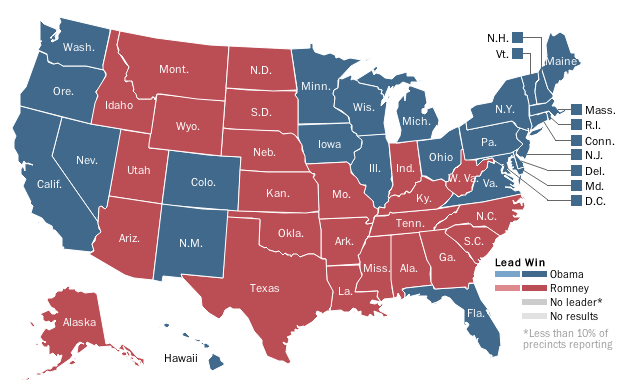 When I saw this on Election Day, the layout of the states immediately stuck out to me. Governor Romney took nearly all of the middle portion of the U.S., while President Obama took nearly all of the coastal states. If we generalize, we could say that the mid-continental states are predominantly white farmer communities, while the coastal states are bustling centers of immigration and young people.
But why can’t the Republican party seem to capture the votes of these emerging demographics? This, I believe, comes down to something that transcends ethnicity.
The Character of a Nation
The day after the election, David Simon, creator of the HBO show The Wire, wrote:
I was on an airplane last night as the election was decided. As the plane landed after midnight on the East Coast, I confess that my hand was shaking as I turned on my phone for the news. I did not want to see dishonesty and divisiveness and raw political hackery rewarded […] But the country is changing. And this may be the last election in which anyone but a fool tries to play — on a national level, at least — the cards of racial exclusion, of immigrant fear, of the patronization of women and hegemony over their bodies, of self-righteous discrimination against homosexuals.
There is a fundamental shift happening in the worldview of the United States. Evangelicalism is declining, opening the door for a more liberal approach to life. Biblical doctrines are being seen as quaint and outdated, and a new generation, which is experiencing a global connection unlike any in the past thanks to the Internet, is deciding they want to be more inclusive. People in Africa or the Middle East live a certain way and we accept them, so why shouldn’t we accept different views in our own nation?
Thus, three states approved gay marriage amendments, several openly gay politicians were elected, and a pro-choice, pro-gay president was re-elected. Further, people like Baxter and Simon are saying, “The current GOP is wrong politically and wrong morally. We must re-make it.”
“Wrong morally.” This isn’t just about thinking one candidate’s policies are better than the other. The very nature of how American citizens see the world is changing. What used to be called biblical values is now being called, “the patronization of women and hegemony over their bodies” and “self-righteous discrimination against homosexuals.”
Again from Simon:
[R]ight now, the conservative movement in America is fleeing from dramatic change that is certain and immutable. A man of color is president for the second time, and this happened despite a struggling economic climate and a national spirit of general discontent. He has been returned to office over the specific objections of the mass of white men. He has instead been re-elected by women, by people of color, by homosexuals, by people of varying religions or no religion whatsoever.
These words will not fall on deaf ears; Republicans, as much as any other political group, want to win votes and be in positions of power, and if it takes compromising on “core” values to get them, they will, because we are all human, and without Jesus biblical values are a convenience. As Baxter also wrote:
[W]ithout fixing these issues, the party doesn’t stand a chance. The first step is to change the party’s positions on the issues listed, and to call out the intolerant elements within the party who have gone untouched for too long.
How Then Shall We Live?
This is the first political post I’ve written on my blog. As the header states, my usual topics are “Creative Writing, Jesus, and Media”. So how does the election fit in?
At first I wasn’t sure if it would, but after thinking over the moral issue I realized it all comes down to my relationship with Jesus. The question I’m asking him is, “If my nation is continually walking away from what You say in the Bible, what do I do with my beliefs?”
An obvious answer is prayer. Regardless of my beliefs, President Obama has been re-elected as the leader of my nation, and I will honor him and pray for him. Also, despite the change happening to those around me, I really do believe that God can turn a nation back to him—not back to Republican values, but to him. How many times did Israel turn from the Lord, only to come back? (Of course, that usually involved captivity or occupation by another country, but that’s a topic for another day.)
But the real tension comes in every-day life. When I interact with homosexuals, or talk with parents who think it’s fine for their five-year old son to become a girl, or read articles like Simon’s that vehemently rejects biblical conservatism, or when I next go to vote, what will my actions be?
Do I say that I believe homosexuality is wrong, but that’s just a personal conviction and it’s okay for you to do what you want because we are a free country? Do I stop saying that abortion is wrong? Well, actually that argument I’m at least sure of; I don’t see how you can look at a ultrasound and not see it as life.
Huh. That last paragraph is interesting. The economy seems like an easy case of numbers, and foreign policy just an exercise in being nice to other nations and being careful where we send guns and bullets. But somehow the real fabric of America’s turmoil can be boiled down to the definition of love and life. Jesus seems pretty clear on these issues—and more and more my homeland is walking away from them.
I’m not going to propose an answer, because in all honesty I don’t know what to do. Our nation is abandoning its Christian roots and I have no arguments against it except my belief in Jesus and his words. What do you do when your nation no longer recognizes that as an acceptable argument?
When you think about it, though, that’s what most of the world experiences. The United States of America is a rarity in history, and I wonder if it has caused us to become complacent in how we walk out our relationships with the Lord. Everyone seemed to go along with our beliefs, so we coasted by.
Now that we are truly confronted with the tension of being in the world but not of it, what will we do?
UPDATE: Daniel Lim, a teacher and missionary, spoke to the students of the International House of Prayer University, a ministry school in Kansas City, Missouri. He provides a clear, urgent answer to my question.
UPDATE 2: A few people have expressed concern that in my post I implied those who voted for President Obama are immoral and walking away from Jesus, and that I think very lowly of them. Regardless of varying opinions, I want to always honor and value you, the reader, and I sincerely apologize for coming across like that.



Leave a comment