• As a follow-up to my last post about creative frustration, here is the longer portion of Ira Glass’s talk from which the video on taste was taken. It’s one giant encouragement to keep. making. things.

  • Improv Short Film shoot
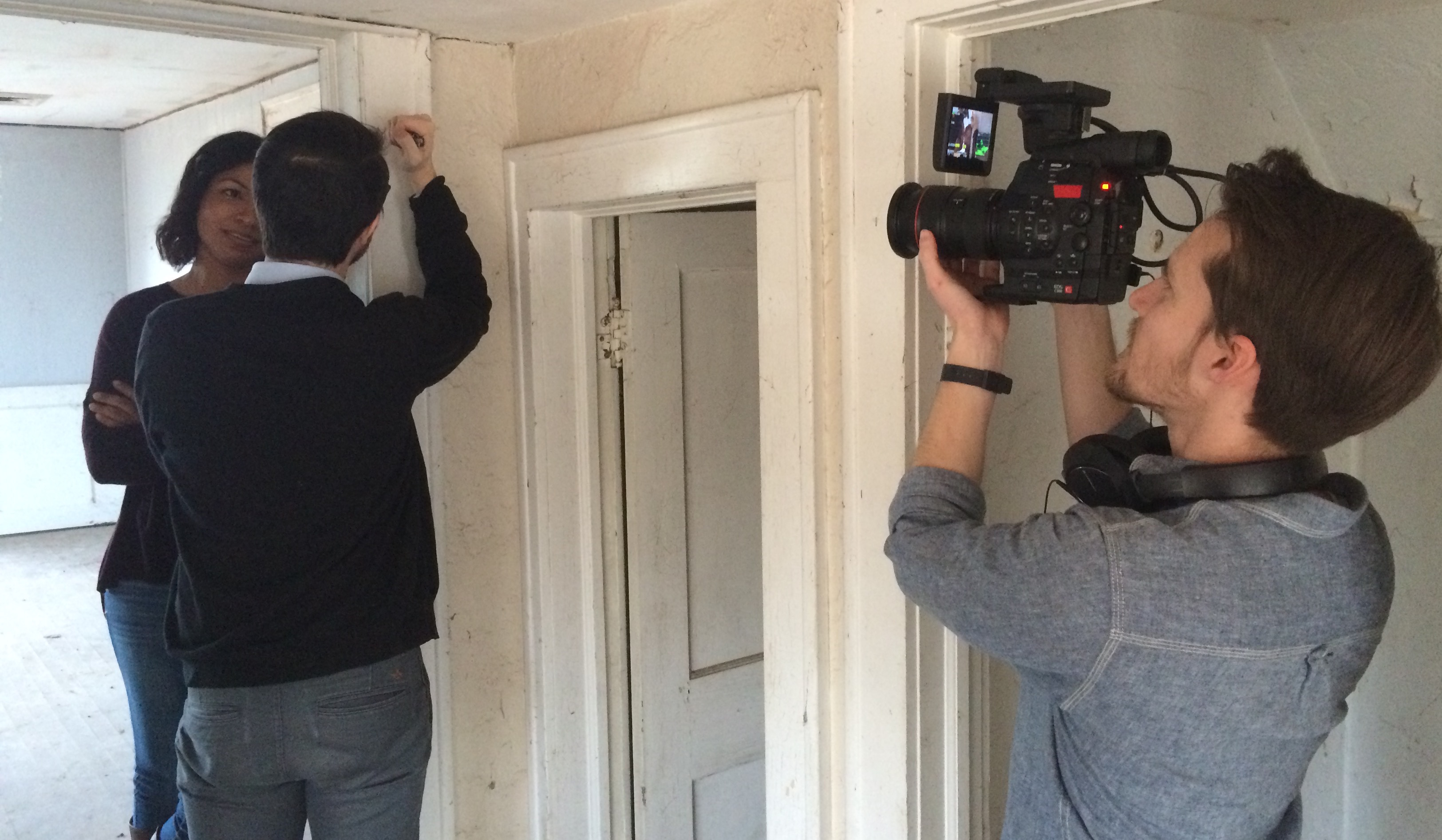
    Actors Heather Rodriguez and Joshua Willis, with camera operator Ben Edwards

    Last weekend I made a short film. The whole thing was improvised; all we had when we started was a location and three actors. There were moments of standing around as we talked, and I tried not to get too stressed. It was a new experience, making up a story on the fly, and I felt like I needed to give answers quickly—something I don’t normally do. Thinking about it later, I realized another part of my anxiousness was because there was something I was reaching for that I couldn’t think fast enough to grasp.

    I have that feeling often. An image doesn’t look quite right, or a sentence doesn’t ring with the right note. I know the right thing—the best thing—is out there but it dances just out of sight. I feel frustrated that I can’t catch it. But I reach and I reach, fingers ever empty, heart ever hungry. Because I know it’s there. I see it in films by Paul Greengrass, Rian Johnson, David O. Russell, and Terrence Mallick. I read it in books by Brandon Sanderson, Stephen Lawhead, Kenneth Oppel, and Christine Fletcher. There! my mind screams, as I try to drink it in, as I try to digest what I have seen or read or heard, and felt. There is where I want to be!

    Ira Glass calls this desire the Gap—the distance between my current skill and my taste.

    When I saw this video for the first time, it gave words to what I was reaching for. Processing it again now, I think there are two aspects to the desire to be “There”:

    • The desire keeps us reaching. The great artists I love became great because they didn’t stop reaching to be better, nor did they stop stretching themselves. They expanded their ideas of what was possible by looking at great work and then tried to do the same with their own projects. Like Ira said, they were willing to put in hours and months and years—and now we all see the payoff. For myself, I am encouraged that some day I will get there. It probably won’t be the next book I write, or the next film I direct, but if I keep reaching one day I will be “There”.
    • The desire can become unthankfulness. When I look at the work of great artists, it is so easy to fall into the trap of comparison. It’s easy to think that I could never measure up to that. When that thought comes, I start to wonder if I really am an artist, if maybe I should think of a plan B career. I start to focus on what I’m not, rather than appreciated what I am able to do. I can also lose sight of the fact that every great artist I love was once in my position, reaching for something their skill didn’t yet match.

    So I think I need to walk my artist’s journey with patience and thankfulness clasped between my hands. When I’m frustrated that my skill isn’t reaching my taste, I need to remind myself that it’s possible to close that gap if I just keep learning and making. When lifting my eyes up to the greatness of the works around me I need to not judge myself inadequate by comparison, but rather see it as encouragement that I can grow through time and dedication.

    Clarification: What I wrote about here has nothing to do with the people I worked with. They all were fantastic and I really enjoyed working with them. The frustration is with myself, in reaching for something that I can’t yet attain. But hopefully with practice I’ll be able to grow and close the gap between my taste and my skill.

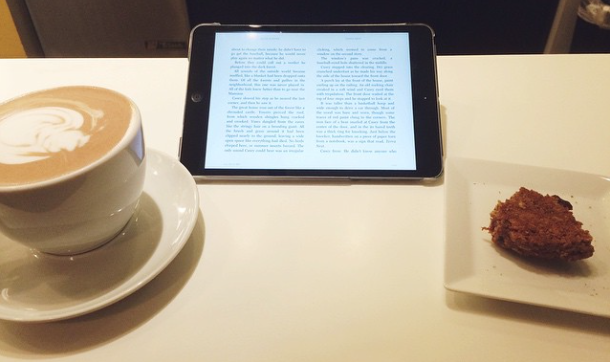
  • With a cup of hot chocolate in one hand and an oatmeal-dried cherry cookie in the other, I read through the first draft of my new short story today. I just finished it on Friday (I think?), and so this is my first step toward revising it. Unfortunately I’ve never been one of those people who reads it once without taking notes to “really experience the story”. I tried it in college, and I tried it today, but I just can’t help myself. I am compelled to take notes.

    short story revision

    This is a test run, in actuality. On February 1st I’m going to start revising my first full-length novel and this short story seemed like a good testing ground for how I’m going to do it. My plan thus far, in loose order, is:

    • Read first draft in iBooks on the iPad
    • Highlight character names and locations
    • Highlight any story points I think may be helpful
    • Develop character and location descriptions based on previous list
    • Clarify character motivations using previous descriptions
    • Critique the story points and structure with character motivations in mind
    • Write second draft

    I had a hard time staying awake while working on the first couple steps today. I’m not sure if that’s a sign of a bad strategy or just lack of sleep. I’m hoping for the latter (he says as he writes at 1:51 AM). But I do think this will be a good strategy.

    iBooks in particular is going to prove helpful, I think. Highlights can be added as I read, along with any notes I want to jot down pertaining to the highlighted words. The list of notations can then be exported in a list and emailed to myself; colors, highlighted text, and chapter location are retained. That will prove useful, I think.

    There is a lot of thinking and hoping going on here, probably because this is an unproven workflow. But again, that’s why I’m glad I have this short story to try it on before jumping into the novel.

    So tomorrow I’ll start the character and location descriptions (or possibly Monday, since on Sunday I’m going to church, shooting an improv short film, meeting with a client to talk about freelance videos, and hanging out with friends. Boy that day filled up quickly). I’m looking forward to it.

    A QUICK WORD ABOUT THIS POST

    Before writing this, I had a thought about using my blog differently this year. I was looking for a website that talked about fiction writing and its process, along with a thoughtful look at life and stories. While I’m sure there is something like that out there, I couldn’t think of any, so I thought, why not write it myself? As such, this post is a little more stream of consciousness with random asides. We’ll see how it goes.

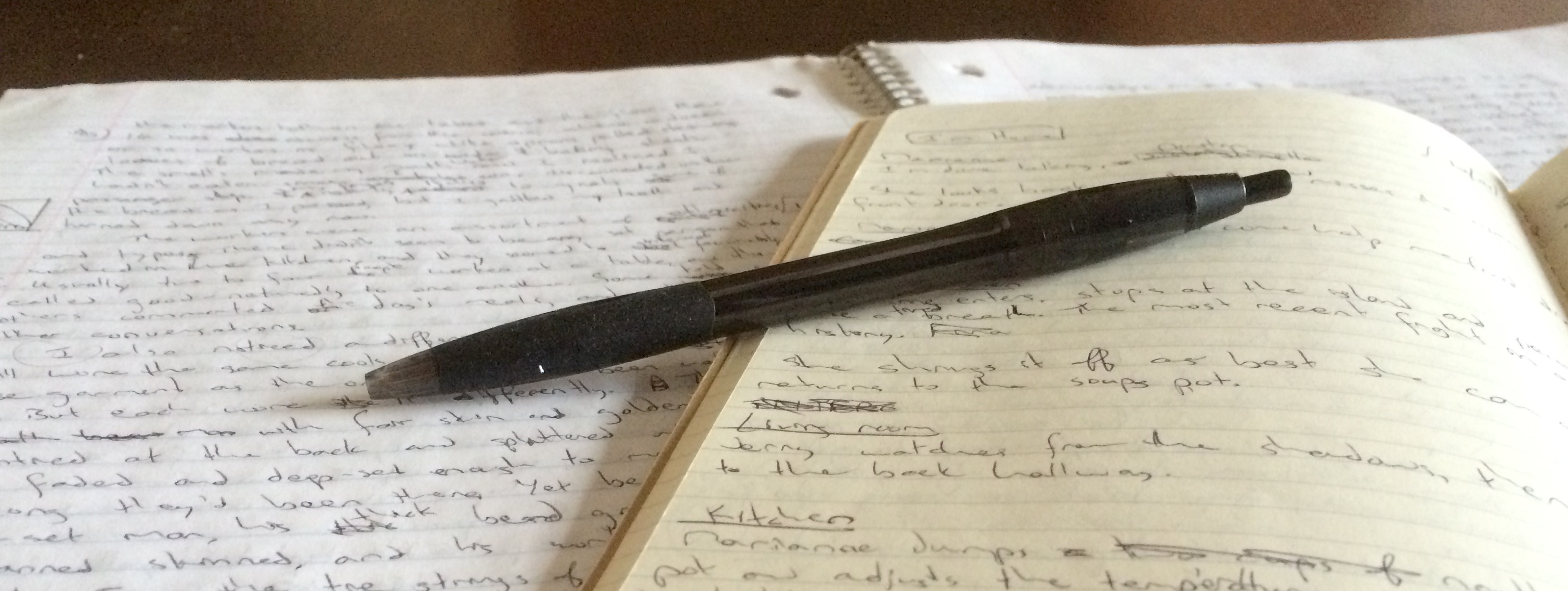
  • Writing in Review 2014 notebooksAt the beginning of 2014, I gave myself a simple goal: write 250 words a day. Writing consistently has always been a goal of mine, but lofty dreams of writing for an hour every day have never materialized. So I decided to aim low and go for something ridiculously easy to reach.

    One year later, I’m blown away at where that simple goal brought me. I kept track of how many words I wrote and for how long using a spreadsheet in Google Docs. It added a bit of extra time, but now I can look back over the past year and see how I did.

    The Numbers

    January through April was pretty consistent. I only missed a few days in each month. Numbers for May through July, however, were very low. My word count was under 2500 for all three months. That’s around the time I decided to rework the outline for my novel, so I lost steam.

    Halfway through August, I started writing again with a fresh outline. That pace continued every day for the rest of the year.

    All told, I spent 114 hours writing 165,391 words in 2014. I broke 2,000 words in a day several times, the largest being 2,469 words on December 18. And I ended the year with writing every day for 135 days.

    In the midst of all those numbers, I finished the first draft of my current novel. While I have started other novels before and even wrote a fantasy book in high school (because we’ve all done that, am I right?), this is the first novel I intend to revise and publish. It was a great day when I crossed the finish line. I couldn’t help but grin as I walked out of the coffee shop.

    It is no stretch to say that 2014 was my most productive year of writing ever. I’m humbled at how small, steady efforts can achieve big things.

    What I Learned

    After writing consistently for a good portion of 2014, here are a few things I learned:

    • Setting a timer helped tremendously. It gave me an immediate goal, and even if I didn’t want to write that day I could tell myself, “Just ten minutes. You can do it.” Once I could meet that time easily, I increased it to 15 minutes. By the end of the year I was averaging 30 minutes a day.
    • The choice to write every day didn’t get easier, but staying in the chair did. I thought gradually I would want to write, but it was always a choice I had to make. Once I was actually writing, though, my stamina to continue greatly increased. While doing National Novel Writing Month (NaNoWriMo) in November, I wrote close to an hour every day.
    • I can write more than I thought. This is largely due to NaNoWriMo. I had to write 1667 words every day, and at first it was extremely daunting. But I found that by pushing myself, I could reach that goal. Discovering that I was capable of more than I thought was very encouraging.
    • I know how much I can write, and how long it takes me.  Thanks to keeping track of my daily numbers, I know I can write about 1000 words in 30 minutes. Having that data helps me know how much time to set aside during the day if I want to meet a certain goal. I’ve found that if I don’t know how long something is going to take, I generally never do it, so this data helps dispel the myth of not having time to write.
    • Planning ahead helps me find time to write. If I know I’m going to busy all day on a given Thursday, then I need to not wait until the very end of the day to write (like today :/…) Just simply thinking about when in the day I’ll be able to write helps me find time to do it, like in the few minutes before I leave for work or while waiting for a wedding to start.

    This year I’ve relaxed my goal of writing every day, but I’m glad I focused on it in 2014. It trained me to be consistent, it worked my creative muscles and expanded them, and it encouraged me that I can, in fact, write an entire book. It was always a far-off dream, and now it’s reality.

    Goals for 2015

    With a solid year of writing behind me, I have a few new goals for this year. The first goal, and one that needs more than a bullet point, is to write with God.

    As I compiled my list the things I had learned in 2014, I realized none of them had to do with my relationship with Jesus. It shocked me that I spent 114 hours, almost a whole week, on something and didn’t grow in my relationship with the Lord.

    That is probably an extreme statement, and of course not everything in life reveals something about the Lord. (How many hours have I spent brushing my teeth?) But writing is a creative endeavor, and I want to get to know the Creator better while I do it. It seriously felt like a blow to my heart to think that I hadn’t learned anything about him while I was writing. That needs to change in 2015. I don’t want to look back in a year and say again, “I spent a solid week of my life doing this and didn’t grow in love for the Lord.”

    So far I’ve found two ways of doing this. The first was suggested by my friend and fellow author Andy Sheehan. When he was writing his fantasy novel years ago (see what I mean?), he would go for a walk and pray for a certain time period, then write for a chunk of time. If he wanted to keep writing, he would walk and pray again. I think that is a fantastic idea. Second, I want to find books about creativity and the Lord and read a small section of it before I write. The book I think I’ll start with is Pursuing Christ. Creating Art. by Gary A. Molander.

    With that foundation in place, here are some other goals:

    1. Finish the second draft of my novel by August. 
    2. Attend the Realm Makers writing conference in August and pitch my novel. I’ve never pitched anything, so that will be a new learning experience!
    3. Submit two short stories for publication. If I only do one story, I could take all year to do it. Submitting two forces me to at least get one done.
    4. Write 6 comic book issues. This project has been outlined for a year and needs to be written!
    5. Write a short film screenplay. I have a rough draft for one finished, and another idea simmering.

    Looking over this list, I’m realizing I can’t relax my goal of writing every day. That doesn’t mean I won’t give myself a day off now and then, but these things won’t write themselves.

    What did you learn in 2014? Any goals for the new year, or book recommendations? I’d love to hear about them, so write a quick comment below. Here’s to writing in 2015!

  • Several years ago I sat down with a friend outside of our work place. Micah Rose had an idea for a short film, and since I was fresh out of film school I said, “Let’s make it!”

    After working on the script for three years, we finally did in 2011. I’m thankful we waited, because the cast we were able to get wouldn’t have been old enough back in 2008! I’m proud that Flower was my first post-school film, and I’d like to share it with you.

    DESCRIPTION:
    Lola is a seventeen-year old girl struggling with broken relationships. When she discovers she is pregnant, everything she hoped would give her meaning is put in jeopardy.

    FESTIVALS:
    Kingdomwood Film Festival 2013 – 2nd place, short film narrative
    Free State Film Festival 2013 – official selection

    CREDITS:
    Written, produced, and directed by Micah Rose Emerson & Jesse Koepke
    Cinematography by Benjamin Edwards
    Original Score by John Samual Hanson
    Edited by Jesse Koepke
    Color Grade by Aaron Williams

    CAST:
    Lola – Ariel O’Bannon
    Lawrence – Joseph Anderson
    Mom – Shelby Keith
    Young Lola – Olivia Prior
    Counselor – Laurie Crawford

I’m Jesse

Reading, writing, fantasy, adventure, movies—it’s all been my favorite since I was 8 years old. If you enjoy reading fantasy, adventure fiction, and screenwriting, then you’re in the right place!

Let’s connect