• 2015 Reading list copyAnother year has passed, which means it’s time to look back at the books I read! This is the sixth year I’ve put together this list, and I love the feeling of history when I look back through past years. An index card serves as both my bookmark and a record of the books I’ve read, and I like to imagine my kids looking through a stack of these some day, to see what I read. These blog posts in turn are a record of which books I liked, new authors I discovered, and the influences I have as a writer.

    So without further ado, here was my 2015 reading list:

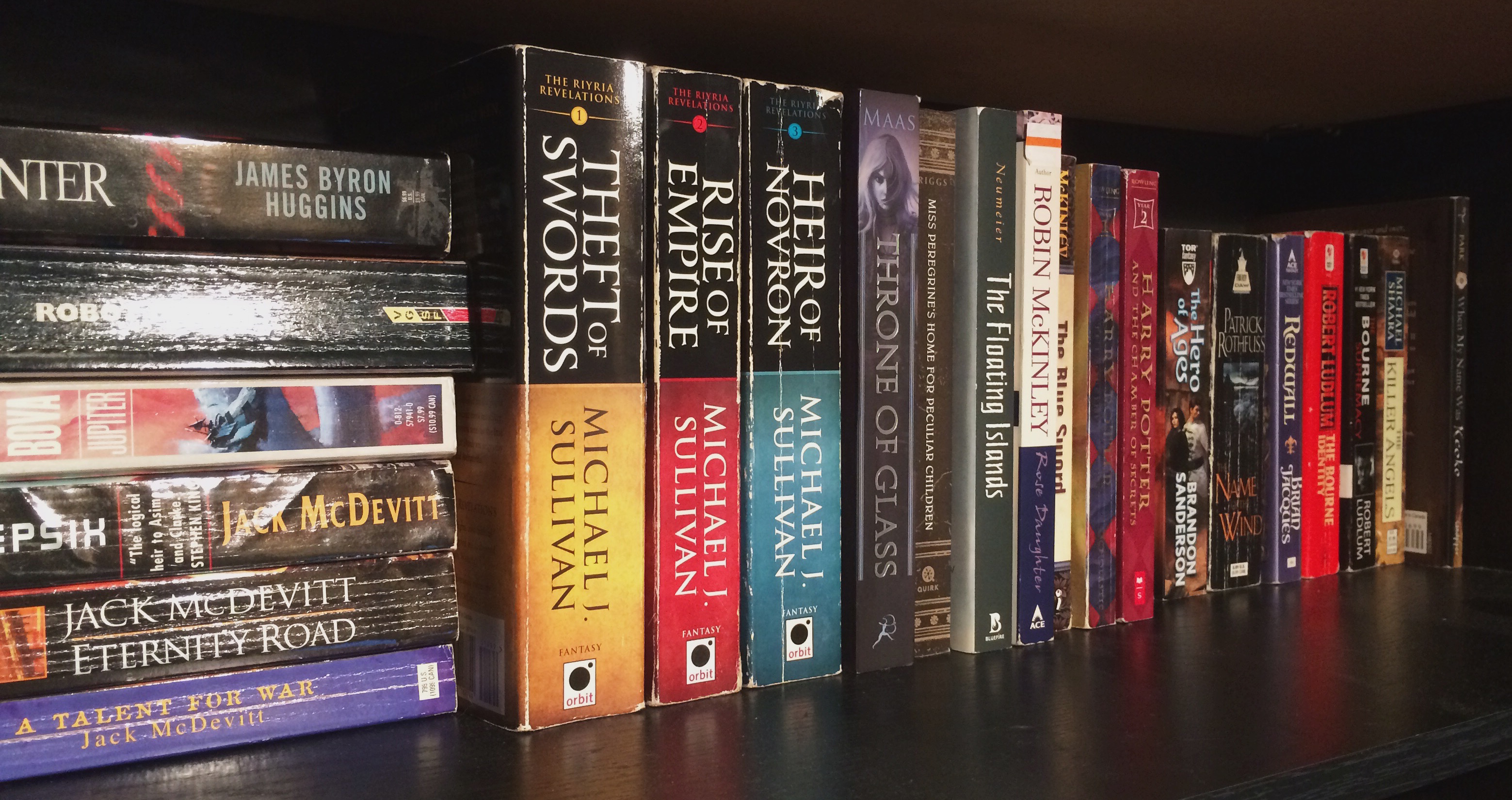
    1. 2014–1/18: The Way of Kings, by Brandon Sanderson
    2. 1/25–2/24: Jupiter, by Ben Bova
    3. 2/24–3/3:  Harry Potter and the Sorcerer’s Stone, by J.K. Rowling
    4. 3/5–3/13:  Harry Potter and the Chamber of Secrets, by J.K. Rowling
    5. 3/17–3/30: Harry Potter and the Prisoner of Azkaban, by J.K. Rowling
    6. 2014–5/6: A Shepherd Looks At Psalm 23, by Phillip Keller
    7. 3/31–5/14: Words of Radiance, by Brandon Sanderson
    8. 5/18–6/14: Harry Potter and the Goblet of Fire, by J.K. Rowling
    9. 8/1–9/5: Holy is the Day, by Carolyn Weber
    10. 9/5–9/30: Runelords, by David Farland
    11. 9/30–11/15: The Inklings, by Humphrey Carpenter
    12. 11/15–11/21: Ancient Shores, by Jack McDevitt
    13. 11/22–12/24: Assassin’s Apprentice, by Robin Hobb
    14. Shadows of Self, by Brandon Sanderson (audiobook)
    15. Redshirts, by John Scalzi (audiobook)

    Favorite Authors

    The big thing I did this year was return to Harry Potter. Back in 2010, in a blog post about why I stopped reading the books, I said:

    “But always that feeling creeps back in, that fascination, whispering and luring me into another world that distracts me from rather than encourages my walk with the Lord.”

    That feeling would come back any time I’ve thought about reading the books since college, so I never picked them back up. Then early in 2015 I saw one at the store and thought about reading it. I was surprised to find that feeling wasn’t there and I excitedly dove in. The first four books were really enjoyable to read and I’m looking forward to the fifth. The feeling still hasn’t returned, but I’m paying close attention to how I feel while reading the books just in case. Maybe once I’ve finished the series I’ll do a follow-up to my previous post.

    I read three new fiction authors this year: David Farland, Robin Hobb, and Ben Bova. All three were enjoyable, but I particularly liked the first two. David Farland’s Runelords was an awesome discovery after I attended sessions he taught at the Realm Makers writing conference. A lot of writing advice says to keep the story moving, but David was willing to pause and describe the world and what was going on. Robin Hobb’s Assassin’s Apprentice has been on my to-read list for a while and it did not disappoint. She has a Dickensian style, rich and well described, and I really liked it.

    Jack McDevitt remains my favorite sci-fi author (Ancient Shores only took me a week to read), and of course Brandon Sanderson is still the premiere fantasy author of our day. Words of Radiance was, like the first book in the series, a masterpiece.

    Books in 2016

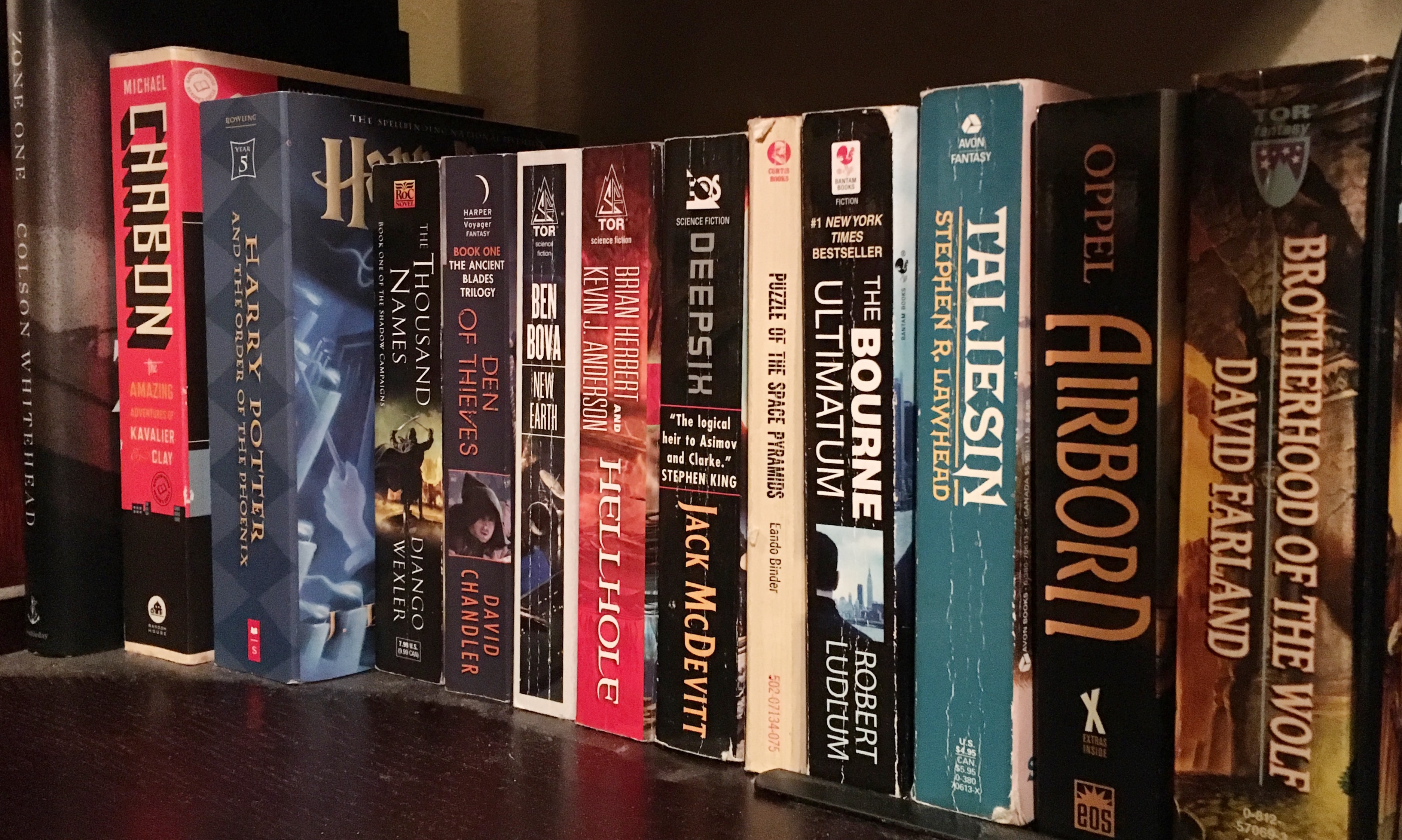
    I started something new in 2015: I dedicated a part of my bookshelf as a to-read queue. Currently it holds more books by Ben Bova and Jack McDevitt, as well as a couple new authors like The Thousand Names by Django Wexler and Den of Thieves by David Chandler. I don’t know if I can finish Harry Potter this year, but Book 5 is on the shelf.

    I would also like to read more history this year. In recent years I’ve fallen out of my plan to alternate between fiction, theology, and history, and I’d like to get back to that. Ones on my mind are Empire by Niall Ferguson, 1421: The Year China Discovered America by Gavin Menzies, and Lost Cities of the Incas by Hiram Bingham.

    The last thing I would like to do this year is reread some of my favorite authors. Craig Mod wrote in his fantastic essay about the value of physical books, “Future Reading“:

    To read a book once is to know it in passing. To read it over and over is to become confidants. The relationship between a reader and a book is measured not in hours or minutes but, ideally, in months and years[…]

    We are embedded in our libraries. To reread is to remember who we once were, which can be equal parts scary and intoxicating.

    Craig reminded me that there have been a few authors who have impacted me, both on a writing level and who I am as a person. Stephen Lawhead is one who gave me a picture of Christ as King; Kenneth Oppel inspired me to dream of adventure and flying free in the clouds; Frank Peretti and Ted Dekker showed me how a story could be biblical without preaching. I want to go back to those books, some of which I’ve only read once, and see what it can teach me again.

    So there you have it! I hope this gives you some ideas for what to read in 2016. If you have recommendations from your year of reading, please let me know!


  • Some dedicated soul cut together all the lightsaber duels from the first six Star Wars episodes. 1 hour of lightsaber action? Yes, please.

    And because I spent way too much time watching this and enjoy the geekier things in life, below are some filmmaking/sword fighting/Star Wars thoughts, all in an attempt to decide which lightsaber duel is the best.

    The Criteria

    In my opinion, a lightsaber duel in film should be graded on four criteria:

    1. Swordplay – are we in awe of the participants’ skill with a “blade”?
    2. Emotional tension – do we emotionally care about who wins the battle?
    3. Shot composition – is the duel filmed in an interesting and energetic way? Wider shots that are on screen longer can help showcase the skill of the duelers and maintain the illusion that holy cow—these guys are really fighting!
    4. Creative use of environment – does the fight move through different spaces? Are there unique obstacles that change the tempo and style of the duel?
    5. Bonus: Music – some fights don’t have music, while others do. Both are used to strong and weak effect.

    The Prequel Trilogy

    With these four (+ bonus) things in mind, I think the prequel trilogy started out incredibly strong. The final duel with Darth Maul is perhaps the second strongest fight of all six films. It easily meets all four (+ bonus) criteria. The sword play is dazzling, accentuated by the wide shots and low angles that pan with the action.Screen Shot 2015-08-20 at 5.44.10 PM This is the desperate fight against the Sith, who could destroy everything the Jedi have worked for, so emotional tension is at a peak. (Plus this was the first lightsaber duel in 16 years, and also the most energetic Jedi/Sith fight audiences had ever seen.) The environments move from the hanger to those walkways around huge beams of light and then into some bizarre tunnel with rotating shields, which give the fight moments of tense silence and frustrating separation. As a bonus the music here is really strong, especially when [[SPOILER!!]] Qui Gon is killed. [[END SPOILER]]

    From there, though, the duels drop off precipitously. The next real duel between lightsaber-weilding masters is with Count Dooku, but the emotional tension is low. Yes, Dooku is the bad guy they’ve been searching for, but why are they searching for him? Is he the guy in charge of the taxes or the blockades? And how the heck did he accidentally bend his lightsaber?! The swordplay doesn’t really dazzle—to me it looks like they’re trying to hit each other’s swords instead of each other—and the fight takes place in just one area of a nondescript hanger.

    Screen Shot 2015-08-20 at 5.49.24 PMWhat really breaks this duel, though, is the use of close-ups in the middle of the fight. Sadly this shot becomes a frequent sight in the following duels. It lacks any context for where the duelers are or what is happening with the lightsabers. Thus the tension of “Will his arm get chopped off?!” is lost.  To top it off, most of this fight has no music and it just feels awkward and lifeless. To top off that top-off, the use of CG for the location and body doubles lacks any weight or authentic texture. (I’m not arguing against the use of CG entirely. We wouldn’t have lightsabers without it, after all.)

    To give a contrasting example, just think back to the duel with Darth Maul—or check out this amateur lightsaber duel. It is also between two Jedi and a Sith, but the wide shot and fast movement through the parking lot result in far more energy and tension than the fight with Dooku.

    The only thing that saves the Dooku duel from obscurity is Yoda, who for the first time flips and spins and is all-around awesome and not old. I’m sure that got a huge cheer in theaters.

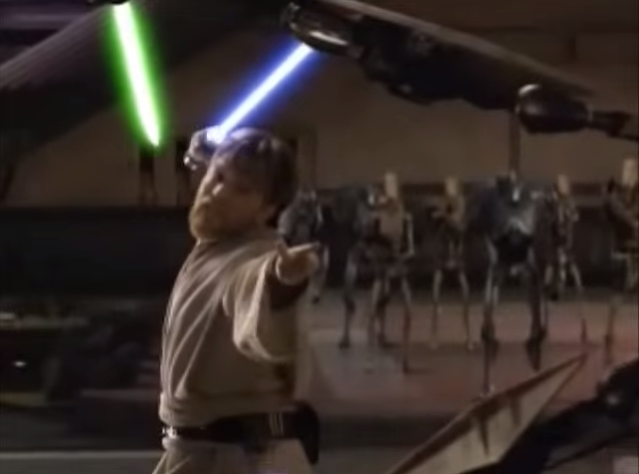
    Screen Shot 2015-08-20 at 11.35.23 PMScreen Shot 2015-08-20 at 11.35.30 PMThe next several fights all blur together. Even Obi-wan fighting General Grievous with four (FOUR!) lightsabers holds no tension, despite covering the most ground out of any of the fights. Or maybe it’s that I can’t take that two-finger pose of Obi-wan’s seriously.

    The next fight of note could possibly be the one between Yoda and the newly-revealed Emperor. There’s a good amount of emotional tension there and the fighting is decent, but other than Yoda’s present the fight doesn’t feel unique. Plus it quickly shifts into a force-throwing battle instead of a duel, which as we all know is a different conversation entirely ;)

    Thus it’s not until Obi-wan and Anakin face off at the end of Episode 3 that we finally get another good lightsaber duel.

    Screen Shot 2015-08-22 at 12.14.48 AMAnd what a duel it is. Emotional tension is definitely high. This is the showdown the whole prequel trilogy has been leading to, and boy do Lucas & Co. let it rip. The fight itself is the longest duel in the six films at over 10 minutes long and has over 1000 moves, according to the actors in one of the behind-the-scenes videos. They make excellent use of environment, moving from landing pad to control room to walkways to lava shields! to lava flows!! —gasp for breath–

    The fight does have close-ups and a lot of pointless lightsaber spinning (that one part in the control room where they both spin their lightsabers around and around before clashing still makes no logical sword-fighting sense to me), but what saves this duel, I think, is its relentless pace and skill (never have we seen two master Jedis fight to the death), incredibly high emotions (“You were supposed to destroy the Sith, not join them!”), and some of the most stirring, tragic Star Wars music John Williams has composed.

    It also has my favorite shot in all of Star Wars:

    Screen Shot 2015-08-22 at 12.19.23 AM

    There is such tension in that shot! And the music hits such a beautifully tragic, epic note. I would watch Episode 3 just to get to this moment. George Lucas is not without cinematic genius.

    Given how much I’ve praised it, you might be surprised I would say this duel only ties for third best. That’s because the duel with Darth Maul is so tightly choreographed, well paced, and shot that it has an immediacy and efficiency that this duel seems to be missing.

    (Side note: I like that they included an insert of Obi-wan picking up Anakin’s lightsaber. He had to do that in order to give it to Luke in Episode 4.)

    The Original Trilogy

    At last we arrive at Episode 4. The duel between Darth Vader and old Obi-wan gets high emotional marks, both because Obi-wan is [[SPOILER!!]] about to give his life so Luke & Co. can get away [[END SPOILER]] and because this was the first lightsaber fight anyone had ever seen. That second fact, though, also means that the swordplay lacks any vigor or creativity and the fighters barely move from where they stand, let alone throughout the room. Shot composition is decent, but nothing noteworthy.

    Screen Shot 2015-08-22 at 12.26.12 AMThe next thing that is noteworthy is the first time Luke duels Vader. Emotional tension is high, obviously, and—unlike the Dooku duel—the lack of music lends the fight a sense of dread, both because we know the fate Vader has planned for Luke and also because the only sounds are the buzz of lightsabers and Vader’s ominous breathing. The fight makes excellent use of the environment and the silhouettes of Luke and Vader crossing lightsabers is one of the iconic Star Wars shot. The only criteria that I wouldn’t give high marks to is the swordplay; Luke is still learning and the moves are mostly feints and slashes.
    If it weren’t for the earlier duel with Darth Maul, the first Luke/Vader duel would probably come in second for best fight. Instead I would put it at a tie for third with Obi-wan vs. Anakin. The second and final Luke/Vader duel, however, maxes out each criteria.

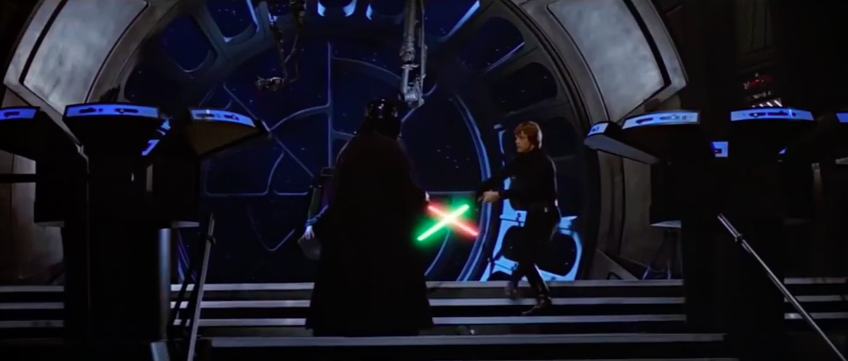
    Screen Shot 2015-08-22 at 12.35.53 AMNot only was the ending of Episode 6 the final film of the original trilogy, in the big picture it’s also the end of the six-film cycle. All twelve hours of film have been leading to this showdown and at last Luke is ready to fight. Emotions are high from the start—but the film doesn’t stop there. Several times throughout the fight the emotions are cranked up: the Death Star is actually operational, the rebels are no longer winning, Luke accidentally reveals his sister to Vader, Luke almost goes to the dark side, the emperor starts killing him–gasp!–The newer versions of the film make the mistake of cueing Vader’s turn by adding audio, but in the theater audiences had no idea which side Vader would choose until he makes his move. Talk about emotional!

    (Side note: it’s interesting how similar the two frames from Luke and Vader’s fights are. Both are fought on a flight of steps, both in black. The only thing that has changed is Luke now stands where Vader once stood. Perhaps an intentional nod to the Emperor wanting Luke to take his father’s place with the dark side?)

    The swordplay is more involved than their first meeting and does a great job of illustrating the emotional state of Luke. The fight makes use of the entirety of the emperor’s chamber: they move down the steps from the emperor, Luke jumps up to the second level in possibly my favorite flip in all of filmdom, they fight under the second level in the shadows, they fight along the walkway and railing, and they look down into the chasm below.

    Screen Shot 2015-08-22 at 1.00.18 AMShot composition is spot on, moving from wide shots as Vader and Luke fight to intimate close-ups of Luke worrying about his friends. The desperate image of Vader clinging to the railing as his lightsaber is hammered from his hands has always stuck in my head. Lastly, the music supports the duel magnificently, aided by that foreboding choir.

    Conclusion

    For me that final duel of the six films takes the trophy and concludes the original trilogy in the best way possible. It squarely hits all four (+ bonus) criteria.

    So to recap, here are my top three fights:

    1. Luke vs. Darth Vader final duel (Ep. 6)
    2. Qui Gon and Obi-wan vs. Darth Maul (Ep. 1)
    3. Obi-wan vs. Anakin (Ep. 3) / Luke vs. Darth Vader first duel (Ep. 5)

    It will be interesting to see what a new generation of lightsaber duels looks like in Episode 7 and beyond. One thing I noticed is there are no duels with female Jedi. We do see a few female Jedi but none of them are involved in the main duels. I’m hoping J.J. Abrams & Co. bring some diversity to the fights, and also treat the duels like the classic sword fights of old.

    If they need some ideas, they can take a cue from this amateur duel, which still remains one of my all-time favorites. (Hint: it fulfills all of the criteria superbly, particularly lightsaber skill and environmental use.)

    Now if only I could find a compilation of all the times a lightsaber is dropped….

    What are your favorite fights? Are there other criteria to consider? Let me know!

  • Photo Mar 30, 10 49 52 PM

    In the summer of 2008, I sat outside a coffee shop and listened to a friend describe an idea for a short film. I was fresh out film school and quickly said, “Let’s make it!” That simple sentence started a journey that lasted four years, resulting in the short film Flower.

    The thing is, it could have been made a lot faster. The co-creator was great to work with and final script was only fifteen pages, but I dragged my feet for three years on the project. It wasn’t until recently that I finally realized why: from the characters to the story to the message, I wanted everything to perfect.

    I do this a lot in life. I once prayed a year and a half about whether to ask a girl out or not; I made another short film two years ago that no one has seen because I haven’t found the best way to release it; a short story I’m writing is on its seventh rewrite; and I just debated two weeks on which camera bag to buy. I analyze, critique, rethink, question, and stress over what is the best decision. Because if there’s anything I don’t want to be, it’s flawed.

    ///

    There is a place for excellence, but I think the question is, what’s driving it? Is it to present the best thing I can, or to keep others from laughing? Too often I think my motivations fall under the latter. That is not perfectionism, but fear.

    And when you think about it, what is more central to the human experience than mistakes? From our first breath we do things imperfectly—yet our parents don’t trade us in for a better model. We all fall, we all come up short, we all make mistakes, and what I’m learning to accept is that it’s okay.

    ///

    Three years after starting the script, the co-creator and I decided to finally just make the film. We held auditions for the cast and ended up with two phenomenal lead actors, ages 16 and 18. The film went on to be accepted to two festivals, win second place in one, and be offered a small distribution deal. More importantly, we still hear stories to this day about people who have been impacted by it.

    All of this is due in no small part to our cast, and if we had made the film earlier they would have been too young.

    It’s to the glory of our Storyteller that he not only allows us to make mistakes and learn, but he then weaves something beautiful from our worn and broken threads. As I toil over a project or anxiously debate about a decision, I hear him say over and over:

    “It’ll be okay. I won’t trade you in. Just do your best, and I’ll take it from there.”

  • 2014 reading list post

    I’m a couple months late in posting this, but I finally had time to jot down what I read in 2014. Unfortunately at some point during the year I lost the index card on which I kept track of what I read, but I think I was able to remember most of them. So here are the books I read in 2014, in no particular order.

    Favorite Authors

    My surprise find of the year was Sharon Cameron. Her steampunk novel The Dark Unwinding was imaginative and brilliantly worded. Her turn of phrase on some occasions and ways she flipped the character’s expectations were thrilling to read. She also had a great blend of that creepy feeling often found in classic gothic novels, similar to Kenneth Oppel in This Dark Endeavor. (Side note: I adore those two titles.)

    After being introduced to Brandon Sanderson in 2013 with his Mistborn trilogy, I continue to be amazed at his writing on so many levels. He is ridiculously prolific and imaginative with his magic systems (they are all completely different and detailed). The highlight of his books, though, are the characters. Nowhere was this more evident than in The Way of Kings. Each character has such a deep emotional journey, and the payoff at the end is jaw-dropping. And this only the first book in a 10-part series! I’ve never committed to a massive, multi-part series before but I am definitely going to keep reading the Stormlight Archives.

    James S.A. Corey wrote an exciting series of books starting with Leviathan Wakes. I think the first book is the strongest, but the whole series is adventurous and does a great job at expanding the story beyond what you thought it was going to be.

    Lastly, Frank Peretti nailed it with his latest book Illusion. I’ve been a Peretti fan since ninth grade when I was finally allowed to read The Oath, but his recent books haven’t engaged me the same. Illusion turned out to be a fantastic book, and very moving in parts.

    Books for 2015

    This year looks like it will mostly be filled with sequels and new books from favorite authors. Sharon Cameron has a new book coming out called Rook, and Rachel Hartman, who wrote Seraphina, one of my favorite books of 2013, just released Shadow Scale. These two women are excellent writers, and I’m excited to see what they’ve come up with.

    Other sequels are Sarah Maas’s Crown of Midnight and of course Words of Radiance, book two of Sanderson’s series. (He also has a follow-up to Steelheart. How does he make time for all of this?!)

    I’ve also decided to read through the Harry Potter series. I wrote several years ago about why I didn’t finish them, but I think I’m ready to. So far the first two books have been great and I’m excited to finally finish the series.

    Alrighty, enough talk. Let’s read. If you have any book suggestions, let me know in the comments!

  • New Sites

    For the past several years my nightly web surfing consisted of visiting the following websites:

    1. Shawnblanc.net, a blog about Apple, tech, and design.
    2. Marco.org, a blog about iOS app development and tech
    3. Loopinsight.com, a blog about Apple, iOS app development, and tech
    4. The Verge, a site about all things tech and pop culture

    Here’s the thing: I am involved in a lot of creative environments, film and fiction writing being foremost. But iOS app development has never been one of them. Yet every night I would spend time looking at all these tech sites unrelated to both my job and the projects I did on the side.

    I knew these things were outside of my regular sphere, but I shrugged it off as a guilty indulgence. I do find the Apple/tech world intriguing so after a while I just went with it. I would listen to podcasts like Accidental Tech Podcast, which is all about development. I would sketch app ideas and even considered learning how to code apps. But in the end it was just a side hobby. Actually, not really a hobby. More like a vague interest.

    At the start of 2015, I decided to change things up. What if I spent my time reading websites that wrote about the things I’m directly involved in? It’s only been a couple months into this experiment and I am loving it.

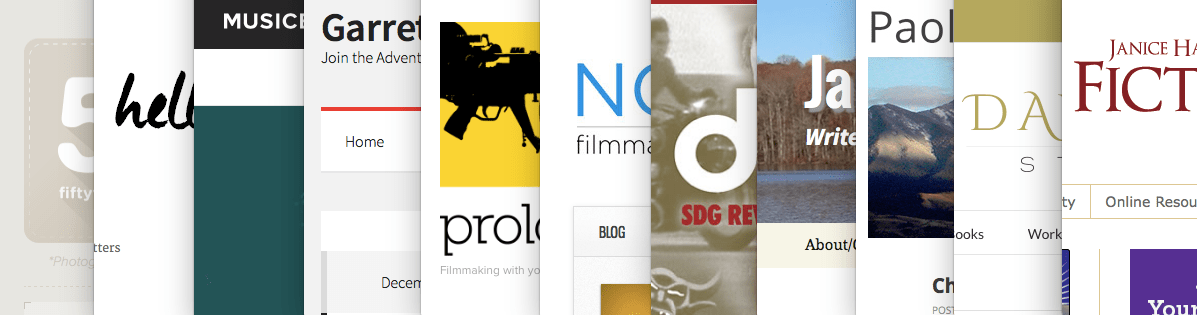
    Here are a few sites I’m trying out:

    1. Fifty Foot Shadows, thoughts on life and photography
    2. Analog Senses, thoughts on life and photography
    3. Prolost, thoughts on and products for film
    4. The Dissolve, film editorials and reviews—great content here!
    5. Jamie Todd Rubin, the writing life
    6. Janice Hardy’s Fiction University, consistently insightful writing advice
    7. Backchannel, a new addition with well-written, in-depth tech articles
    8. Suggestion of Motion, in-depth articles about film, specifically the Panasonic GH4, which I own
    9. Garrett Koepke’s blog—my brother is writing some great stuff about travel, with beautiful photographs
    10. The Music Bed Community—at first just a stock music site, TMB have become so much more

    This is a longer list than I used to check, but that is offset by the fact that they post less frequently. Instead the pieces are more focused on really thinking about a topic. It’s a slower pace that I’ve come to appreciate. And yes, there is still a tech website on there. That’s because Steven Levy writes some of most insightful, engaging, and well-written articles about tech I’ve found.

    After just a couple months of changing the websites I read, I’m already feeling a difference. Reading Fifty Foot Shadows and Analog Senses has inspired me to get a film camera and try my hand at slower paced, more focused photography. The editorials by The Dissolve and Stu’s writing at Prolost is helping me be more thoughtful about my filmmaking—a category to which I’m excited to add The Music Bed.

    The point is, I’m reading good writing about the topics I daily interact with. The content is encouraging and inspiring me in the things that I create, and I’m really thankful that I made the change.

I’m Jesse

Reading, writing, fantasy, adventure, movies—it’s all been my favorite since I was 8 years old. If you enjoy reading fantasy, adventure fiction, and screenwriting, then you’re in the right place!

Let’s connect