A Different Standard
This weekend marks the release of Pixar Animation’s thirteenth film, Brave. The anticipation is high for the story about a young princess in tenth century Scotland, and rightly so. Every one of Pixar’s previous films has been met with success on all fronts, from critical acclaim to box office results to Academy awards to the most basic of measurements, audience enjoyment. You would be hard pressed to find anyone of any age who didn’t enjoy at least one of Pixar’s stories. Like no other modern movie studio, Pixar can be counted on to deliver time and again.
They’ve become so good that they are graded on a different curve than the rest of Hollywood. In his review of Brave for the LA Times, Kenneth Turan opens by saying, “If the Walt Disney Studios logo were the only one on Brave, this film’s impeccable visuals and valiant heroine would be enough to call it a success. But Brave is also a Pixar Animation Studios film, and that means it has to answer to a higher standard.” Even Cars, Pixar’s weakest film (in my opinion, though not the opinion of many a five-year old), was still better than most other movies. The question everyone is wondering is, how? How does Pixar succeed so well with every single movie, and why can’t anyone else?
The strange thing is, Hollywood can’t seem to find an answer. Despite watching Pixar rake in enormous amounts of money (we’ll get to that soon), studios continue to produce remakes, adaptations (of boardgames), and sequels. How many times have you looked at the theater listings or scrolled through your Netflix options and turned away in dismay because there was nothing interesting or new to watch? I am to an extent generalizing, because there are legitimately good movies out there, but the average temperature of reaction to Hollywood’s offerings is tepid at best.
There are very smart people working in Hollywood, don’t get me wrong. It just seems bizarre to me that no one else can get it right. Geoff Boucher, writing for LA Times’ “Hero Complex”, put the question to Brad Bird in an interview a few months ago.
GB: Pixar is widely admired but, really, rarely copied. Why do you think that is?
BB: Everyone in Hollywood says they wish they could do it like Pixar, but they really don’t. There’s no secret at Pixar, but there is a belief in letting people pursue something with passion and take chances, and most of Hollywood, really, doesn’t like that. It’s too scary. Some studio executives will say they love obsessive creators who take risks, but really most of them would rather play it safe. Projects cost a lot of money and people would rather follow patterns they know and make things safe and accessible. Hollywood wants there to be a math formula for making hit films. To make something really great and different and interesting means taking risks and following these ideas in your head.
Reading this interview, it suddenly clicked for me why Pixar does so well, and it’s summed up in this sentence from Brad: “Projects cost a lot of money and people would rather follow patterns they know and make things safe and accessible.”
The pressure of financial obligation in Hollywood is stifling creativity.
Money, Money, Money
The reason studios can’t take the risks Brad is talking about is their budgets are enormous. It’s no shock these days to hear about studios spending $200M (million) on a film. When you’re spending that kind of money on something, you had better be sure you’re going to make that money back. So studios stick with the safe bets, the works that have a pre-established audience (like Twilight, The Hunger Games, and comic books). They stick with ideas they know can sell—which results in unoriginal rehashes of what worked last year.
The need for financial success is especially true in today’s changing market. Due to accessible equipment and the internet as a viable distribution method for independent filmmakers, the amount of content has skyrocketed. Thus the $100M spent on movies by audiences is split between 100 films instead of twenty. If you’re going to spend $200M on a movie these days, you really have to know something is a sure bet before you make it.
For example, John Carter was recently made for $250M. It’s domestic box office gross was $73M. The international box office increased that to $282M, so they fortunately made back their budget, but numbers like that would freak me out if I were a studio executive. That can only happen so many times before you file for bankruptcy, such as New Line Cinema did shortly after releasing The Golden Compass for $180M but only grossing $70M domestically. Things like this only drive studios farther into their shells of comfortability. When you invest that much money in something, there is enormous pressure to earn that money back—which means you stick with what you know works.
By contrast, let’s look at the numbers for Pixar’s films:
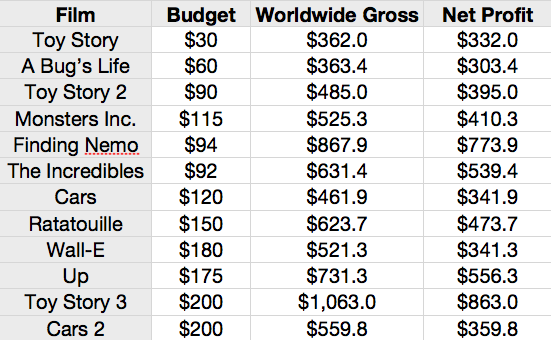
After doing some math, here’s what we can learn from these numbers:
- Average budget: $125.5M
- Average worldwide gross: $599.6M
- Average profit: $474.1M
Other studios would give anything to have those numbers. Now, granted, the costs for a live-action film are going to be different from an animated film. You’re not just paying animators and voice actors. But the point is, you don’t have to spend $200M to make a great movie. Despite what Hollywood thinks, lots of money ≠ a great movie. (One more point of comparison: The Hunger Games was made for $78M, and its worldwide gross was $661M.)
The average budget for the first six Pixar films was $80M. The costs even went down after Monsters Inc. You could argue that Finding Nemo was cheaper because the story was set in the ocean and didn’t need as much set decoration—but then The Incredibles was even cheaper, even with big action pieces and lots of characters.
The average profit for those first six films? $459M.
These numbers are important because we can see a consistent choice by Pixar to keep budgets small as they started out. This meant they could take greater risks with their stories. The smaller budgets gave them the freedom to try new things and figure out how to be a movie studio, how to function as a creative team, and how to consistently develop good stories.
And that, I believe, is the crux of it all: at Pixar, story is king. They are not slaves to their budgets. There will always be budget concerns, of course, but with lower budgets Pixar is able to try new things. A story about an ant? Why not? It’s only $60M. A story about a superhero family? Sure, it’s only $92M.
By keeping costs low, Pixar has been able to let the story lead the way. Even to the extent of making massive revisions to films, like Toy Story 2 and Ratatouille, the story is king, not the money, because when money dictates your creative decisions you stick with what’s safe.
Having succeeded with its first six films, Pixar was then able to increase the budgets for the next six. The average budget of films seven through twelve was $171M; the average net profit was $489.3M. But even though budgets increased, by that time the ratio of budget to available income was probably close to the same as the earlier films. By then they had a sufficient amount of profit to still allow for creative freedom.
Three Lessons
Having looked at all of this, I think three of things (among many) to which we can attribute Pixar’s success are:
- Smaller budgets. By removing some of the pressure of succeeding financially, they were able to foster creative freedom and originality.
- Family-oriented films. It’s statistically proven that family-friendly films make more money. On top of that, China and India are two of the biggest markets in the world, and I heard recently that one of them (I can’t remember which) doesn’t accept movies over a PG-rating. So you cut out a significant chunk of potential audiences by merely putting violent, sexual, or foul content into your films. Now sometimes a story legitimately calls for some (key word) of that, such as The Passion of the Christ or Saving Private Ryan. But as Ted Baehr said, “Most people want to see Good conquer evil, Truth triumph over falsehood, Justice prevail over injustice, Liberty conquer tyranny, and Beauty overcome ugliness […] They also would like to take their whole family, including their grandparents, to the movies more often.”
- Story is king. By giving the story the best seat in the house instead of money, Pixar is able to maintain integrity in the vision and not make compromises to follow where someone thinks the market is going.
The temptation Pixar will have to fight is the thinking that technology and effects is making the money. They have to resist the idea that movies can be made by formula and sticking with what worked last time.
At the same time, other studios can’t just replicate verbatim what Pixar has done. Pixar’s mode of operation is giving creativity and originality full reign, and by definition originality means it will always be different. What Hollywood needs to do is look at the principles of Pixar’s process and let those ideas develop how they will in their particular environment.
Story must be King
Audiences—no, humanity—loves creativity and fresh ideas, and that is spoiled by sedimentary thinking—which is pressured into place by exorbitant amounts of money and the pressure to succeed that comes with it. As Brad said, “To make something really great and different and interesting means taking risks and following these ideas in your head.” And that means not having the pressure of money.
So don’t give me $200M. I don’t need it to make a great movie, and I don’t want you breathing down my neck to see if we make back the money.
Actually, wait—I take that back. Give me $200M and I’ll make four great movies.
 Jesse Koepke
Leave a comment